
FAQ Overview
Welcome to the BBAE FAQ, your quick and comprehensive guide to navigating our platform and understanding the essentials of investing with BBAE.

Popular questions
- Alternative Investments and Pre-IPOs26 questions
- Account Opening30 questions
- Account Management23 questions
- Account Funding14 questions
- Corporate Actions & Dividends19 questions
- Fractional Share Investing17 questions
- IPOs12 questions
- Margin49 questions
- Options86 questions
- Regulatory11 questions
- Rewards15 questions
- Trading62 questions
- Transfers26 questions
- Withdrawals7 questions
- Other FAQs19 questions
- Glossary21 questions
Alternative Investments and Pre-IPOs
What is an alternative investment?
Alternative investments are assets outside of traditional stocks, bonds, and cash. Examples include private company shares, private equity, private credit, real estate, hedge funds, and collectibles. These investments often have different risks, returns, and liquidity compared to public markets.
Why consider alternative investments?
They can diversify a portfolio, offer potential for higher returns, provide access to innovation, and, in some cases, hedge against inflation.
What are the risks of alternative investments?
Alternative investments involve unique considerations and risks that differ from traditional investments:
- Liquidity constraints: Private investments typically cannot be easily sold or converted to cash on demand.
- Longer investment horizons: Many alternatives require multi-year commitments.
- Limited transparency: Private investments may offer less detailed or less frequent disclosure compared to public securities.
- Complex structures: Alternative investments may involve sophisticated legal structures that require careful review.
- Higher fees: Management fees and carried interest can be higher than those for traditional investments.
- Valuation uncertainty: Without public market pricing, valuations may be less frequent and more subjective.
- Risk of Loss: Alternative investments are speculative and involve a high degree of risk, including the possible loss of your entire investment.
Are alternative investments insured or guaranteed?
No. Alternative investments, including pre-IPO investments, are not insured or guaranteed by the FDIC, SIPC, or any other government agency. These investments are subject to the risk of loss, including the possible loss of your entire investment.
Are there potential conflicts of interest?
Yes. In connection with alternative investments, BBAE or its affiliates may face potential conflicts of interest, including compensation arrangements, allocation decisions, or relationships with issuers or sponsors. These conflicts are disclosed in the applicable offering documents.
Account Opening
How do I open an account with BBAE?
To open an account with BBAE, download the BBAE app here:
We aim to complete the account approval process within one to two business days if all necessary information is promptly provided. However, if additional verification or documentation is required, the process may take three to five days. Should you have any questions or require assistance during the account opening process, our account services team is available to provide guidance and support. Our goal is to help you meet the requirements and efficiently open and fund your new BBAE account as soon as possible.
I am new to investing, how do I get started?
If you’re new to investing and wondering where to begin, we’re here to guide you through the process. BBAE offers a host of educational tools designed to ease you into the world of investing:
- Start with Our FAQ: Visit the FAQ section here. It’s a treasure chest of information where you can find answers to common questions that most new investors have.
- Explore the BBAE Platform: Within the BBAE Platform, we have the Watchlist and Discover sections. These features allow you to observe market trends, understand potential investment opportunities, and learn how different financial instruments work.
- Read the BBAE Blog: The BBAE Blog is regularly updated with articles that cover the basics of investing, as well as more advanced topics. These articles can help you build a solid foundation of investment knowledge.
- Reach Out for Support: Should you have any specific questions or need further assistance, the BBAE support team is ready to help. Contact us via chat or support@bbae.com.
Remember, investing is a journey, and starting with the right resources can make all the difference. Take your time to learn and grow your confidence at your own pace. Welcome to the world of investing with BBAE!
How long does it take to open my account with BBAE?
Typically, accounts with BBAE are opened within one to two business days. However, if additional information is required, it may take three to five business days to complete the account opening process. Several factors can influence the exact timeline:
- Completeness of information provided: Providing all the necessary information in a timely manner helps expedite the account opening process. Missing or inaccurate information can cause delays.
- Complexity of account registration: Accounts with joint owners, trustees, or complex business structures may require additional time for setup and approval. Our Compliance team carefully verifies all account registrants and authorized individuals to ensure compliance with regulatory requirements.
Once your account is approved and opened, you will receive a welcome email containing your account login details. This will grant you full access to your brokerage account features, allowing you to begin trading or funding your account without delay.
If you have any questions about the status of your account application or encounter any issues, please do not hesitate to reach out to us. We are here to assist you throughout the account opening process and help resolve any concerns to expedite the opening of your account.
What types of accounts does BBAE offer?
BBAE offers individual self-directed brokerage accounts through our wholly-owned subsidiary, Redbridge Securities LLC, a FINRA/SIPC member, and investment advisory accounts through BBAE Advisors LLC, our SEC-registered investment advisor. For entity account inquiries, contact us at support@bbae.com.
MyMarket Accounts:
Emphasizing personal control and autonomy, allowing users to manage their investments using our platform’s trading tools and resources.
- Cash brokerage accounts: The default account type for buying and selling securities with available cash funds only. Suitable for most individual self-directed investors building a portfolio using a mix of stocks, bonds, ETFs, mutual funds, and other assets.
- Margin brokerage accounts: For eligible clients seeking leverage and short selling ability. Margin accounts let you borrow funds from BBAE to buy securities worth more than your deposited cash, up to certain limits. Approval for margin trading privileges is based on eligibility criteria, including experience, risk profile, and account equity. Ongoing margin interest charges apply for borrowed amounts. Margin trading involves additional risks and is not suitable for all investors.
- Options brokerage accounts: For eligible clients seeking options trading privileges for hedging risks or speculation. Approval is based on options experience, risk tolerance, account equity, and other factors. Options trading allows for more complex strategies but also higher risks. Options trading privileges are not suitable or approved for all client accounts.
MyAdvisor Accounts:
Catering to investors seeking a hands-off approach to investing while benefiting from professional expertise. BBAE MyAdvisor partners with market-leading asset allocators to provide active portfolio management, offering personalized, diversified portfolios tailored to each user’s unique financial goals and risk tolerance. This approach combines the convenience of automated robo-advisory services with the insights and expertise of professional investors, allowing users to focus on their long-term objectives. Investment advisory accounts are offered through BBAE Advisors LLC, an SEC-registered investment advisor.
Entity brokerage accounts:
For businesses, partnerships, trusts, and other legal entities. Opening an entity account typically requires additional documentation to establish authorization and verify controlling individuals. Account types and trading privileges available depend on the entity structure and financials. Please contact us for details on opening a corporate or institutional account.
What information is required to open an account with BBAE?
To open an account with BBAE, we need to gather specific information from you to fulfill legal and regulatory requirements. The necessary details include:
- Personal information: Your full legal name, current residential address, date of birth, citizenship, and SSN or tax ID number. This information helps us verify your identity and conduct mandatory background and compliance checks.
- Government-issued photo ID: In some cases, we may need a copy of your non-expired government-issued photo identification, such as a driver’s license or passport. This enables us to verify your identity, prevent fraud, and comply with anti-money laundering laws.
- Financial and risk profile: We require details about your net worth, annual income, investment experience, occupation, objectives, risk tolerance, and more. This information allows us to assess your financial situation and risk profile, ensuring suitable investment recommendations and limits for your account.
The specific information required may vary depending on the account types and privileges you request. For instance, applying for margin or options trading may necessitate additional financial disclosures and agreements. BBAE is committed to maintaining strict security and privacy standards for all personal client information provided during the account opening process and throughout your relationship with us.
If you have any questions about the information needed for your particular account setup or how we use that information, please don’t hesitate to ask. We’re happy to provide clarifications and additional details to help you understand what’s required to get started with BBAE.
Account Management
Where can I find my account balance?
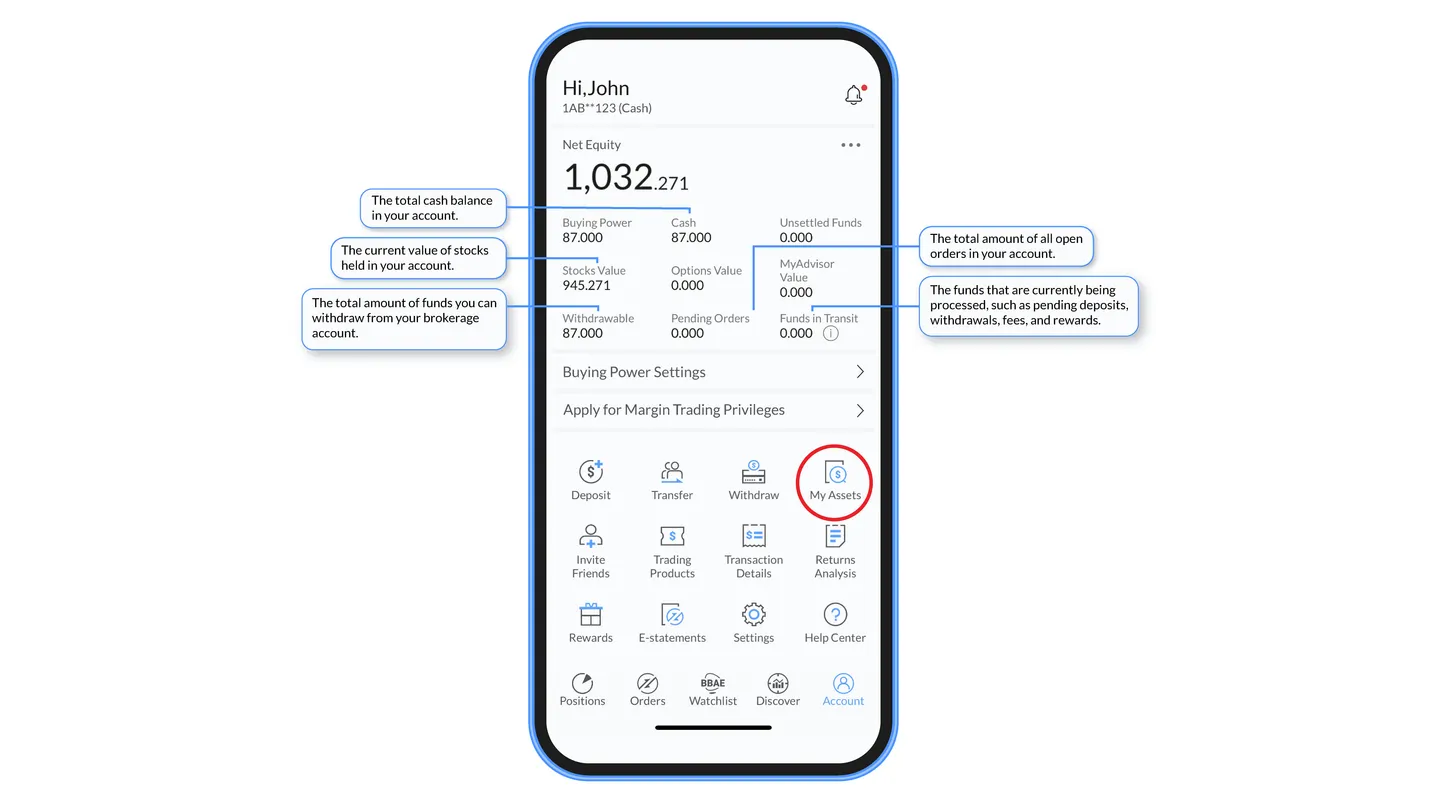
To begin, access the Account tab for a comprehensive overview of your account activity. Here, you can see updates on your stocks value, pending orders, cash balance and more. You can also utilize the My Assets tab to see an overview of your account positions. Please refer to the Glossary to learn more about different factors influencing your account balance.
Where can I find my BBAE account number?
For security reasons, your complete account number is concealed within the main Account page.
However, there are two methods to locate it:
- Navigate to Account, then Deposit, and choose Wire. Your account number will be displayed under ‘For Final Credit’ next to your name, beginning with a 7X.
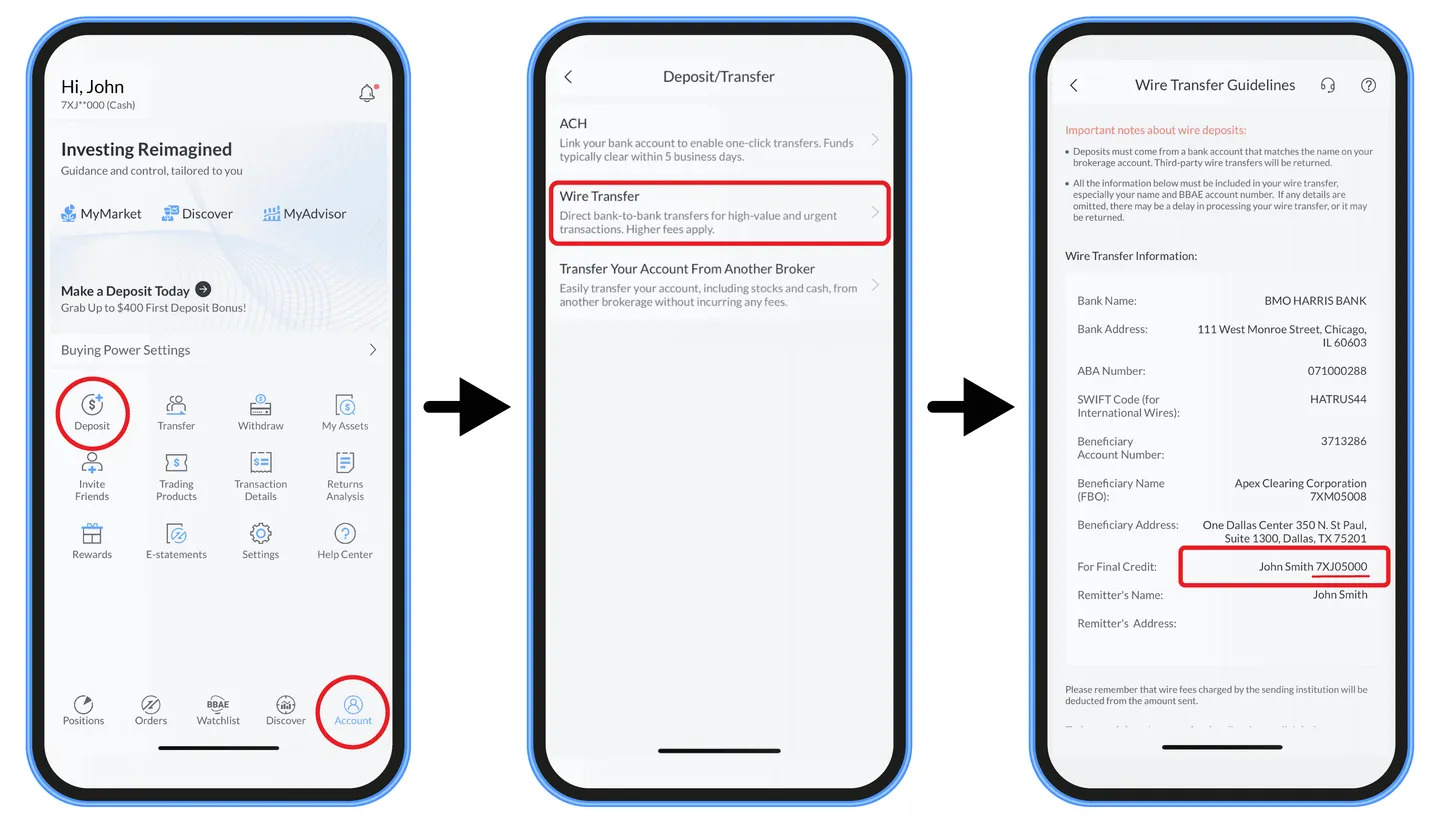
- OR, on the same Account tab, go to E-Statements and choose Account Statements. Your account number will be found in the top left corner of your account statements.
I forgot my password; how can I change it?
To change your password, make sure you are logged out of your account (Account – Settings – Sign Out) and follow these steps:
- Go to Account and then select Sign In/Sign Up.
- Select Sign In.
- Click the Forgot Password link and follow the prompts.
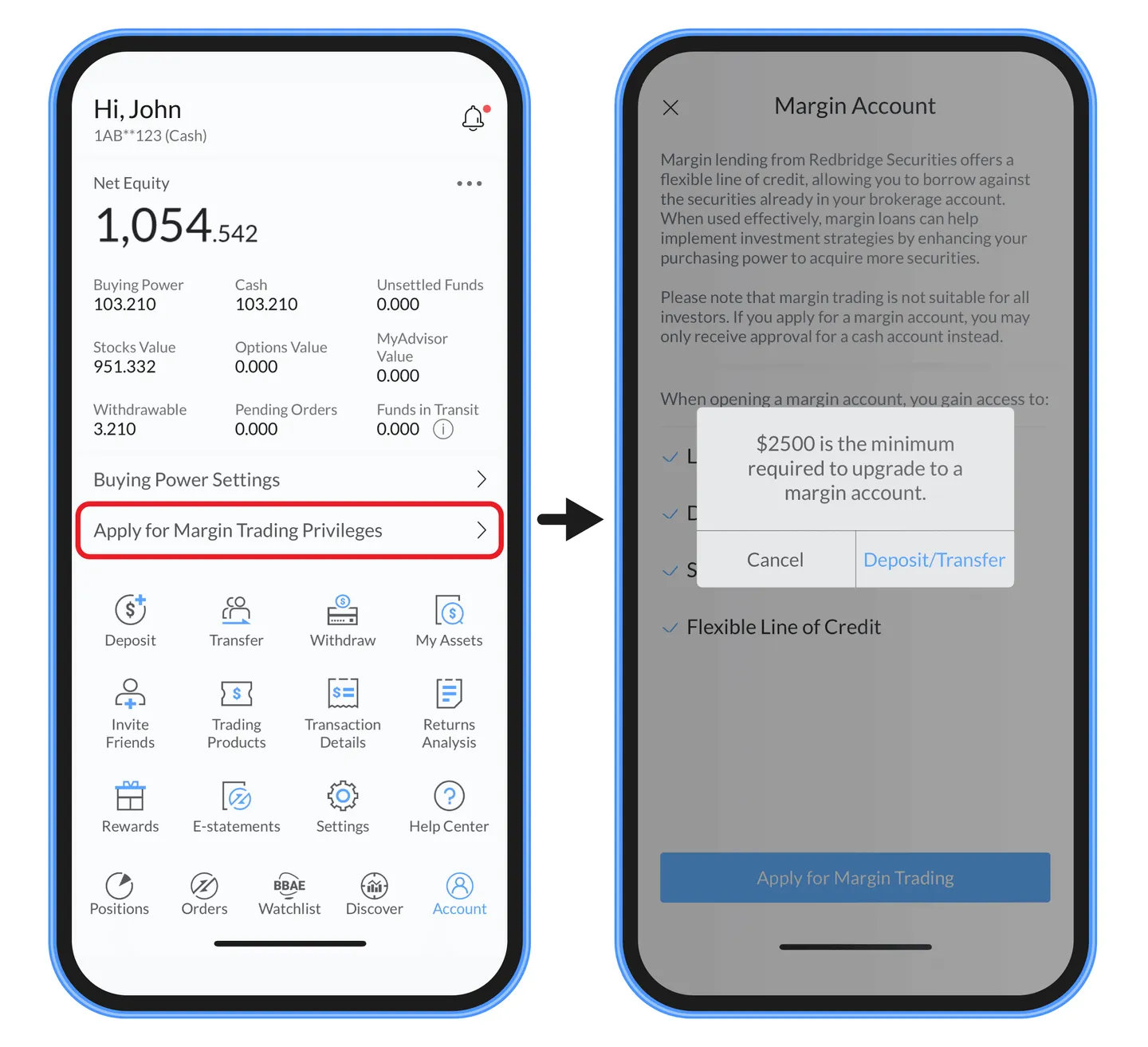
I have a cash account but would like to change it to a margin account. What should I do?
Navigate to the Account section and then click the text that says, “Apply for Margin Trading Privileges”. Please note that you will only see this option if you have funds in your account. To learn more about margin privileges, please click here.
How do I apply for options trading?
To apply for options trading, you must meet specific criteria, such as maintaining a minimum account equity of $1,000 for Level 1 options, for instance. Once you meet this requirement, you can proceed to apply for options. Simply search and select any stock, then click the Options button. You will be guided through a brief options questionnaire to submit your application. For more information on options trading, please click here.
Account Funding
How do I fund my BBAE account?
You can fund your BBAE account via Instant Bank Transfer, ACH, Wire transfer, or ACAT transfer. To learn more about each of these options please continue reading below.
How do I fund my account via Instant Bank Transfer (RTP)?
Real-Time Payments (RTP), or Instant Bank Transfer as it is called in the BBAE platform, are transactions that initiate and settle almost instantaneously. At present, Real-Time Payments are only supported by Bank of America, Citibank, and US Bank. To use this method to fund your account, go to the ‘Account’ section and then to ‘Deposit.’ Choose ‘Instant Bank Transfer’ and proceed as instructed. It’s important to note that you must accept the transfer in your online banking app or via an email from your bank after initiating it. Follow the instructions provided by your bank to do so.
The limits for Instant Bank Transfers are as follows:
- Bank of America:
- $3,500 and 10 transactions every 24 hours
- $10,000 and 30 transactions every 7 days
- $20,000 and 60 transactions every month
- Citibank:
- $10,000 daily
- $15,000 monthly
- US Bank:
- $10,000 per transaction
Deposits made by Real-Time Payments (RTP) are immediately available for investing.
How do I fund my account via ACH?
You can link your bank account through the BBAE platform and set up ACH transfers to move funds from your checking or savings account into your BBAE account. Transfers typically take two to three business days to process and seven business days to fully settle.
Instant ACH Transfer is a speedy option that lets you connect to your bank account and immediately transfer funds. The process involves logging in with your bank credentials through our trusted partner, Plaid, to confirm ownership, which can be completed within minutes. This method is the quickest way to fund your BBAE account and begin investing. It is important to note that not all banks are eligible for instant verification, necessitating the use of micro-deposit verification (more on that below).
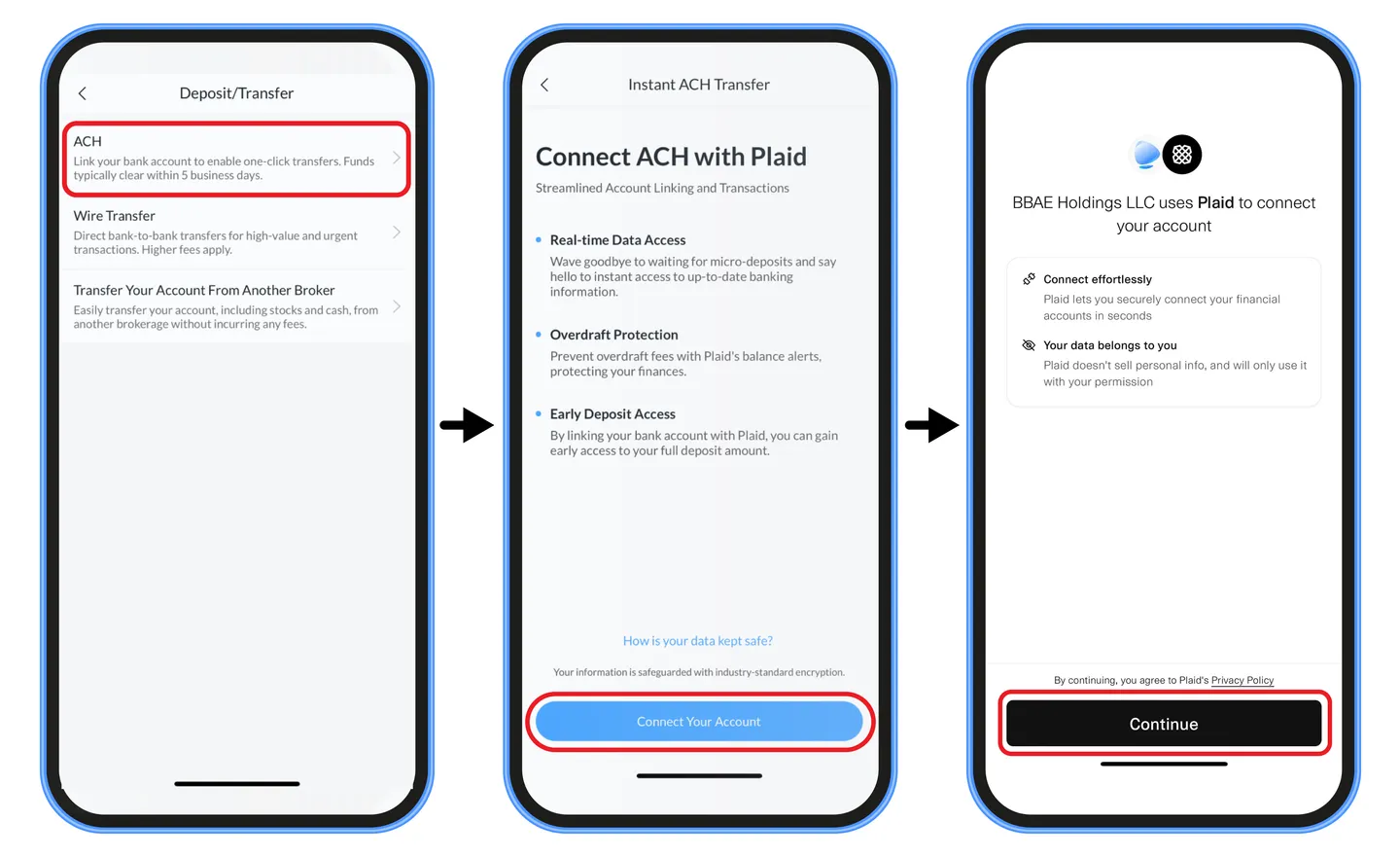
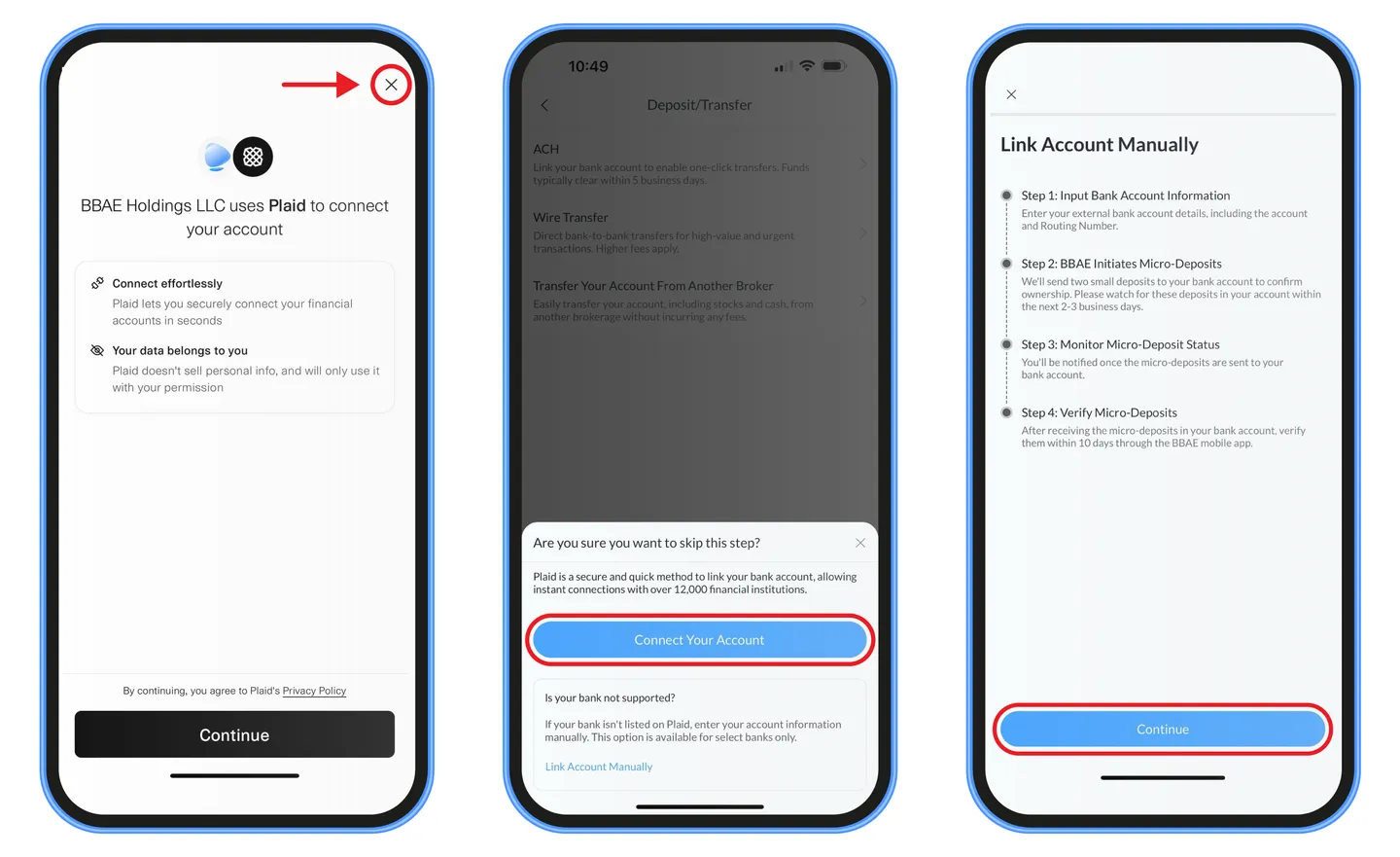
If your bank does not support Instant ACH Transfer, then you can link via Micro-deposit Verification. This is a more traditional approach that involves manually entering your bank account details which includes your routing and account number into your BBAE account. BBAE will initiate a process where small amounts of money, called micro-deposits, are sent to the bank account temporarily. Once received, you can verify the deposits to confirm ownership. This method can take up to 2-3 business days to complete. Please note that if verification is not completed within 10 business days, new micro-deposits will need to be sent. To link your bank account via Micro-deposit Verification, please follow the steps outlined below.
- Navigate to Account – Deposit and then Select ACH
- Click the “Connect Your Account Button”
- Here, you will be prompted to connect via Plaid. Please select the “x” in the upper right-hand corner of the screen to decline.
- On the next screen, select “Link Account Manually” and follow the prompts to link your account via Micro-deposit Verification.
How soon can I start investing after making an ACH deposit?
When you make an ACH deposit, the funds are released to your buying power in three steps:
- Instant Buying Power: All or a portion of your deposit is available for investing immediately as Instant Buying Power, or on the next trading day, depending on when you make the deposit and how you linked your account.
- Deposit Timing:
- Deposits made between 7:30 AM ET and 3:30 PM ET on a trading day are available immediately as Instant Buying Power.
- Deposits made before 7:30 AM ET are available as Instant Buying Power after 7:30 AM ET on the same trading day.
- Deposits made after 3:30 PM ET or on a non-trading day are available as Instant Buying Power after 7:30 AM ET on the next trading day.
- Bank Account Linking Method:
- Plaid: If you linked your bank account via Plaid, the entire deposit amount is available immediately as Instant Buying Power.
- For example, if you used Plaid bank account verification and made a $5,000 deposit, the entire $5,000 amount would be available immediately as Instant Buying Power.
- Micro-deposits: If you used micro-deposits for bank account verification, a portion (at least $1,000 but not more than the deposited amount or your account balance at the time of the deposit) is available immediately for investing as Instant Buying Power.
- For example, if you used micro-deposits bank account verification, you have $2,000 in your account and deposit $5,000:
- Instant Buying Power: You’ll have $2,000 to invest immediately and for the first four trading days.
- Increased Buying Power: From the 5th to the 6th business day, the full $5,000 will be available for investing, but with some limitations.
- Full Access: On the 7th business day, you can use the entire $5,000 for trading without any limitations.
- Increased Buying Power: From the 5th business day to the 6th business day, the amount available for investing will increase to the full deposit amount, but with some limitations.
- Full Access: On the 7th business day, the funds will be fully settled, and you will have complete freedom to use them for trading and withdrawals without any limitations.
It’s important to note that the Instant Buying Power comes with certain limitations:
- Instant Buying Power cannot be used for options trading.
- Instant Buying Power cannot be used to purchase MyAdvisor portfolios.
- Instant Buying Power will not be factored into the calculation of margin leverage.
- Instant Buying Power will not increase the number of day trades allowed.
- Instant Buying Power cannot be withdrawn.
If this is your first deposit or if your account has a zero equity balance, there are additional restrictions:
- Opening positions in stocks with a market capitalization below $500 million is not allowed using Instant Buying Power.
- Funds from the sale of stocks purchased using Instant Buying Power cannot be used to open new positions until the transaction settlement is completed.
All limitations will be lifted on the seventh trading day after the ACH deposit when the funds are fully settled.
How do I fund my account via Wire Transfer?
Wiring funds allows you to transfer larger amounts of money between your bank and BBAE account in one to three business days. However, there are typically fees charged for wire transfers by the sending bank. If any details are omitted, there may be a delay in processing your wire transfer, or it may be returned. The wire instructions to transfer funds into your BBAE account are as follows:
- Bank name: BMO Harris Bank
- Bank address: 111 West Monroe St., Chicago, IL 60603
- ABA number: 071000288
- Swift code (for International Wires): HATRUS44
- Beneficiary account number: 3713286
- Beneficiary name: Apex Clearing Corporation, Your BBAE Account Number
- Beneficiary address: One Dallas Center, 350 N. St. Paul, Suite 1300, Dallas, TX 75201
- For final credit to: Your name and BBAE account number (Example: John Smith 7XJ05000)
- Remitter’s Name: Your First and Last Name
- Remitter’s Address: Your residential address
Please note that deposits must come from a bank account that matches the name on your BBAE account. Third-party wire transfers will be returned.
Corporate Actions & Dividends
What is a Corporate Action?
A corporate action refers to any event initiated by a publicly traded company that has the potential to materially affect its stakeholders and shareholders. These events typically involve changes in the company’s capital structure, ownership, or governance. Corporate actions can be involuntary (or mandatory), initiated by the company itself, or voluntary, where shareholders choose to participate.
Examples of corporate actions include:
- Dividend payments
- Stock splits
- Mergers and acquisitions
- Name and symbol changes
- Rights offerings
- Tender offers
- Spin-offs
- Stock buybacks
These events can have various implications for investors, including potential changes in their investments’ value, ownership rights, and tax obligations.
What is the difference between mandatory and voluntary corporate actions?
Mandatory corporate actions are initiated by a company’s board of directors and apply uniformly to all shareholders. These actions automatically affect investments upon receipt of cash or shares from the custodian, or upon receiving notices of processed allocations. Examples of mandatory corporate actions include dividend payments, stock splits, mergers and acquisitions, and name and symbol changes.
Voluntary corporate actions require a response from investors for participation. When a voluntary corporate action is announced, shareholders are provided with detailed instructions on how to participate. Examples of voluntary actions include tender offers, exchange offers, mergers with an election, odd-lot offers, and conversions.
How will my account be affected when a corporate action is processed?
When a corporate action is processed, your account may experience temporary restrictions on certain symbols. This is to ensure that the event is correctly reflected in your account. The duration of these restrictions depends on when our clearing firm receives all the necessary details and payment from the custodian.
When are corporate actions typically processed?
We strive to process corporate actions ahead of regular trading hours to minimize disruption to our customers. However, the timing of processing depends on various factors such as when we receive all the necessary information and payment from the custodian and the complexity of the corporate action. In some cases, if we receive late notifications, corporate actions may be processed during trading hours. Rest assured that we make every effort to minimize any inconvenience to our customers during these processes.
Will I still be able to trade during this period?
Yes, while your account may experience temporary restrictions on certain symbols during the processing of a corporate action, this should not impact your ability to trade overall. Once the corporate action is processed and the restriction is released, you will be able to resume trading as usual.
IPOs
What is an IPO?
An Initial Public Offering (IPO) is a significant event in a company’s journey that marks its transition from being a private entity to a publicly-traded one. The main purposes of an IPO are to raise capital, increase visibility, and provide liquidity for founders and early investors.
The IPO process consists of several key steps:
- Selecting underwriters: The company partners with investment banks acting as underwriters. They help in determining the offering price, the number of shares to be issued, and guide the company through the complex regulatory environment.
- Filing a Registration Statement with the SEC: The company must file a detailed registration statement with the Securities and Exchange Commission (SEC). This statement includes a prospectus with comprehensive information about the business.
- Setting the final IPO Price: After the SEC approves the registration, the company and the underwriters work together to finalize the IPO price. They consider factors like market conditions, investor demand, and the company’s overall valuation.
- Allocating Shares and Beginning Trading: After pricing, the IPO shares are allocated to investors, and trading starts on a public stock exchange.
Investing in IPOs offers the potential for high rewards because investors can participate in a company’s growth from an early stage. However, it also carries certain risks, including price volatility, limited financial history, and possible overvaluation. Therefore, comprehensive research, reviewing the company’s prospectus, and understanding potential risks are all vital steps before investing in IPOs.
The BBAE platform provides you with tools that make this easier, for example, viewing the IPO prospectus. It offers valuable insights into upcoming IPOs and features stock screening tools to identify public companies with robust growth potential. A balanced approach that considers an investor’s risk tolerance, investment objectives, and time horizon is crucial for long-term success in the IPO market.
In the past few years, the IPO landscape has seen considerable changes, with companies opting for traditional IPOs or alternative methods like direct listings or Special Purpose Acquisition Companies (SPACs). This has led to the emergence of IPO ETFs, which offer investors diversified exposure to newly public companies and an easier entry point for IPO investing.
In conclusion, understanding the IPO process, its implications, and the associated risks and rewards is essential for making informed investment decisions. With comprehensive research and strategic use of tools like the BBAE platform, investors can capitalize on the growth opportunities presented by newly public companies.
What are “Offerings” in the BBAE platform?
“Offerings” in the BBAE platform refer to investment opportunities in the form of initial public offerings (IPOs). An IPO is a method by which a company raises funds by issuing shares to the public. As a user of the BBAE platform, you can choose to participate in these Offerings, allowing you to buy shares at their issue price on the day of listing.
To find Offerings, follow these steps:
- Open the BBAE platform.
- Click on “Discover” at the top of the screen.
- Select “Offerings” from the available options.
This will present a list of current Offerings you can participate in. Keep in mind, there may be specific requirements or limitations for participation. It’s crucial that before investing, you review the details of the Offering, including the company’s prospectus filed with the SEC. This document, accessible within the BBAE platform, provides essential information to help you make an informed decision.
If you need further help or have any additional questions about Offerings, don’t hesitate to contact our support team.
What is the procedure for investing in an IPO through BBAE?
To invest in an IPO through BBAE, ensure you have an active BBAE account with sufficient funds to cover the IPO purchase. The procedure is as follows:
- Open your BBAE account.
- Navigate to the “Discover” tab.
- Select “Offerings” from the available options.
- Browse the list of available IPOs.
- If you find an IPO of interest, click on it for detailed information.
- Review the IPO details, including the offering price, prospectus and associated risks.
- If you choose to invest, select the option to do so.
- Follow the prompts to confirm your investment and finalize the transaction.
Remember, IPO shares are often in high demand and can be allocated on a first-come, first-served basis. Therefore, if you’re interested in an IPO, it’s crucial to act promptly.
What risks are associated with investing in IPOs?
Investing in IPOs can offer potential growth opportunities, but also involves inherent risks:
- Price volatility: Newly listed stocks can experience significant price fluctuations due to factors like limited trading history, market sentiment, and broader market conditions.
- Limited financial history: Companies going public often have short track records, making their performance and potential growth difficult to evaluate.
- Overvaluation: IPOs may be overpriced due to high demand, leading to inflated valuations. When the market adjusts to the company’s true value, the stock price may decrease.
- Lack of liquidity: IPO shares can be subject to lock-up agreements that prevent insiders and early investors from selling their shares for a certain period. When this period ends, an influx of shares could cause a price drop.
- Underperformance: Not all IPOs meet expectations in the long term, and some may underperform due to various challenges.
- Regulatory and legal risks: Public companies must adhere to strict regulatory requirements. Non-compliance can result in legal issues and potential stock price declines.
To mitigate these risks, investors should conduct thorough research and diversify their investment portfolio. Consider the potential risks and rewards of IPO investments as part of your overall strategy.
How do I check the subscription allocation results when I subscribe to an Offering?
To check the subscription allocation results for an Offering, please follow these steps:
- Open your BBAE account.
- Tap on the “Discover” tab.
- Choose “Offerings” from the available options.
- Click on “My Orders” to view your subscription details.
In the “My Orders” section, you’ll see your subscription status updated. On the day of the listing, the investment bank managing the Offering will announce the results. Your subscription status will show as either “Filled” or “Cancelled,” reflecting the outcome of the Offering.
These steps will help you easily track and understand the allocation results for the Offering you’ve subscribed to.
Margin
What is margin trading?
Margin trading is an investing strategy that involves using borrowed money to purchase securities, essentially allowing investors to trade with more money than they have in their account. This method capitalizes on the value of your existing investments, known as “marginable securities,” which serve as collateral for the loan.
In simple terms, margin trading can significantly increase your buying power. This potentially allows for greater investment returns if the securities purchased increase in value. For example, if you buy securities worth $10,000 with $5,000 of your own money and $5,000 borrowed through margin, a 20% increase in the value of these securities would give you a 40% return on the money you initially invested.
However, it’s equally essential to understand that margin trading can magnify not just potential profits, but also potential losses. If the securities decline in value, you will still need to repay the borrowed amount along with any interest accrued. In some cases, if the collateral securities fall below a certain threshold, you may be subject to a “margin call,” where you’ll need to either deposit more cash or sell off assets to meet the minimum margin requirements.
Given its potential for both high reward and high risk, margin trading is generally more suitable for experienced investors who are familiar with market volatility and who can absorb potential losses. We strongly recommend investors to thoroughly understand the implications and risks involved with margin trading before choosing this approach. As with any investment strategy, it’s always advisable to consult with a financial advisor or do your own thorough research.
How does margin trading work?
Margin trading allows you to borrow funds from BBAE to purchase securities, with the securities in your account serving as collateral for the loan. Here’s an example to illustrate how margin trading works, based on the Regulation T initial margin requirements of 50%:
Example:
- You deposit $5,000 into your margin account.
- You borrow $5,000 from BBAE at an agreed interest rate.
- You utilize the total amount of $10,000 to purchase securities worth $10,000.
If the value of the securities in your account rises to $15,000:
- The borrowed amount of $5,000 remains the same.
- Your equity in the account increases to $10,000.
- You gain $5,000 in equity without adding any additional cash.
If the value of the securities drops to $7,500:
- The borrowed amount of $5,000 remains unchanged.
- Your equity in the account decreases to $2,500.
- You experience a loss of $2,500 in equity, although the actual cash loss is only $1,250.
If the value of the securities drops further to $6,000:
- The borrowed amount of $5,000 remains the same.
- Your equity in the account is only $1,000.
- This falls below the margin maintenance requirement, triggering a margin call.
It’s important to understand that margin trading involves risks, and fluctuations in the value of securities can impact your equity and may result in margin calls. It’s essential to closely monitor your account and meet margin requirements to avoid potential consequences. If you have further questions or need assistance regarding margin trading, please feel free to reach out to our customer support team.
How does margin trading increase buying power?
Margin trading essentially amplifies your buying power by enabling you to use borrowed funds to purchase more securities than you could afford solely with your own cash. This process works by leveraging the value of your existing securities, which serve as collateral for the loan.
For instance, if BBAE offers a 2:1 margin account, you can double your purchasing power. This means that with $5,000 of your own money in your account, you could borrow an additional $5,000 from BBAE, giving you a total of $10,000 to invest.
By using this leverage, you have the potential to earn a higher return. If your $10,000 investment increases by 20%, for example, you’d have a $2,000 gain (minus interest on the borrowed money) instead of a $1,000 gain if you had only used your own $5,000.
However, this increased buying power comes with increased risks. While you have the potential to realize greater profits, you could also face larger losses if your investments decline in value. You are responsible for repaying the amount borrowed, regardless of how your investments perform. Furthermore, if the value of your collateral securities drops below a certain level, you may be subject to a “margin call,” requiring you to deposit more cash or sell some assets to maintain the required margin balance.
Due to these associated risks, it’s important for investors considering margin trading to fully understand how it works, the potential gains, and the potential losses.
How can I learn more about margin trading and its regulations?
There are several resources available to learn more about margin trading and its associated regulations:
- BBAE Margin Disclosure Statement: The most relevant resource for BBAE users is our Margin Disclosure Statement. It provides detailed information about the risks associated with margin trading on our platform. You can find this document by clicking here.
- U.S. Securities and Exchange Commission (SEC): The SEC offers an Investor Bulletin that outlines the specifics of margin trading, including the inherent risks, rules, and regulations. You can find this by clicking here.
- Financial Industry Regulatory Authority (FINRA): FINRA also provides detailed resources regarding margin accounts and the legalities surrounding them. You can find this by clicking here.
It’s essential to thoroughly review and understand these resources before considering margin trading. This understanding will help you make informed and responsible investment decisions.
What are the requirements to trade on margin?
In order to qualify for margin trading at BBAE, there are specific requirements that investors must meet:
- Account Approval: First and foremost, you need to apply for and receive approval to trade on margin. This involves completing our margin agreement, which outlines the terms and conditions of the margin account.
- Minimum Equity Balance: A key requirement for margin trading is to maintain a minimum equity balance in your account. As per regulatory guidelines, the minimum equity balance to initiate margin trading is $2,500.
- Margin Disclosure Statement: Before trading on margin, you must read and acknowledge BBAE’s Margin Disclosure Statement, which outlines the significant risks associated with trading on margin.
- Suitability Requirements: Finally, not all investors are suitable for margin trading. You should have a solid understanding of investment principles and strategies, and be comfortable with the risks associated with trading on margin. BBAE may also review your investment objectives, risk tolerance, and financial situation to determine if margin trading is suitable for you.
Please note that margin trading involves a high level of risk and isn’t appropriate for all investors. Always ensure you understand the risks and obligations associated with margin trading before proceeding.
Options
What options trading levels are offered at BBAE?
At BBAE, we offer our clients a range of options trading levels to suit their experience and trading strategies. Here’s an overview of the options trading levels available and the strategies each level permits:
Options Strategies | Level 1 | Level 2 | Level 3 | Level 4 |
|---|---|---|---|---|
Long Calls | Not supported | Supported | Supported | Supported |
Long Puts | Not supported | Supported | Supported | Supported |
Sell Covered Calls | Supported | Supported | Supported | Supported |
Sell Cash Secured Puts (Requires Cash Account) | Not supported | Supported | Supported | Not supported |
Short Covered Puts (Requires Margin) | Not supported | Supported | Supported | Supported |
Vertical Debit / Credit Spreads (Requires Margin) | Not supported | Not supported | Supported | Supported |
Calendar / Diagonal Spreads (Requires Margin) | Not supported | Not supported | Supported | Supported |
Naked Equity Puts (Requires Margin) | Not supported | Not supported | Not supported | Supported |
Level 1: This is our introductory level, designed for beginners. At this level, you are permitted to sell covered calls, which is a relatively conservative strategy where you own the underlying stock.
Level 2: Aimed at more experienced traders, Level 2 expands your trading capabilities. You can now buy options, such as long calls and long puts. Additionally, you can sell cash-secured puts if you have a cash account, and also engage in short covered puts with a margin account.
Level 3: For advanced traders, Level 3 allows the use of all strategies permitted in Level 2, and adds the ability to trade vertical debit/credit spreads as well as calendar and diagonal spreads, which require a margin account.
Level 4: The highest level, designed for expert traders with a high-risk tolerance, includes all the strategies from the previous levels. Level 4 traders can also trade naked equity puts, which involves a significant level of risk and also requires a margin account.
Please be aware that specific account types are required for certain strategies: selling cash-secured puts requires a cash account, while strategies marked with “Requires Margin” need a margin account. Each level has prerequisites that must be met, including your trading experience, investment objectives, and financial situation. We encourage our investors to fully understand the risks associated with each trading level and to trade responsibly.
For further information or if you have any specific questions about our options trading levels, please don’t hesitate to reach out to the BBAE support team.
What are options?
Options are derivative financial instruments that grant investors the right, but not the obligation, to buy or sell an underlying asset, such as a stock, at a predetermined price and within a specific time frame. There are two main types of options: call options, which represent the expectation that a stock’s price will increase, and put options, which signify the anticipation that a stock’s price will decrease. Options can serve various purposes, including hedging against potential losses, generating income, or speculating on market movements.
What are call options?
Call options grant the holder the right, but not the obligation, to purchase 100 shares of the underlying stock at a predetermined strike price. Investors who buy call options typically anticipate the stock’s value to increase, while those who sell call options expect the stock’s value to either decrease or remain unchanged. When purchasing a call option, you have the ability to sell the contract in the market if the stock price rises above the strike price. Conversely, when selling a call option, you receive the premium and are obligated to sell the underlying shares to the option buyer if the stock price climbs above the strike price.
What are put options?
Put options give the holder the right, but not the obligation, to sell 100 shares of the underlying stock at a predetermined strike price. Investors who buy put options generally expect the stock’s value to decrease, while those who sell put options anticipate the stock’s value to either increase or remain unchanged. When purchasing a put option, you can sell the contract in the market if the stock price falls below the strike price. On the other hand, when selling a put option, you collect the premium and are obligated to buy the underlying shares from the option buyer if the stock price drops below the strike price.
What options trading strategies are available?
BBAE offers access to a selection of options trading strategies for customers who satisfy the necessary suitability requirements. These strategies are designed for various risk tolerances and market perspectives:
You can access the following options trading strategies:
- Buying a Call: If you believe the underlying stock’s price will increase, consider purchasing a call option.
- Buying a Put: If you expect the underlying stock’s price to decrease, consider purchasing a put option.
- Selling a Covered Call: By selling a call option while owning the underlying stock, you can generate extra income with the potential obligation to sell the stock if its price exceeds the strike price.
- Selling a Covered Put: Sell a put option while shorting the underlying stock to potentially profit from the premium received if the stock’s price stays above the strike price.
- Selling a Cash-Covered Put: Sell a put option while holding sufficient cash in your account to purchase the underlying stock, with the goal of profiting from the premium received or possibly acquiring the stock at a lower price.
- Vertical Debit/Credit Spreads & Calendar/Diagonal Spreads: Utilize a combination of options with varying strike prices and/or expiration dates to manage risk and potentially profit from diverse market conditions.
- Equity Naked Put: Sell a put option without owning the underlying stock, aiming to profit from the premium received, while bearing the potential obligation to buy the stock if its price drops below the strike price.
Please note that BBAE does not currently support index option trading.
Regulatory
Is BBAE a regulated platform?
Yes, BBAE is a regulated platform. BBAE’s wholly-owned subsidiary, Redbridge Securities LLC, is a registered broker-dealer and FINRA/SIPC member. Redbridge is subject to regulation by the United States Securities and Exchange Commission (SEC) and is a member of the Financial Industry Regulatory Authority (FINRA). These regulatory bodies establish and enforce rules to safeguard investors and maintain fair and orderly markets in the securities industry.
How does BBAE comply with AML regulations?
BBAE, through its subsidiary Redbridge Securities LLC, is firmly committed to maintaining a strong stance against money laundering and illicit financial activities. To ensure this, BBAE has implemented stringent anti-money laundering (AML) policies and procedures that adhere to regulatory standards.
These measures include:
- Customer Due Diligence (CDD): BBAE conducts comprehensive CDD processes to know and understand our customers better. This process involves collecting and verifying the identification data of our customers and understanding their transaction patterns.
- Ongoing Monitoring: BBAE monitors transactions on an ongoing basis to detect suspicious activity. This includes checking for large transactions, rapid movement of funds, or unusual patterns that may indicate potential money laundering.
- Reporting: In line with the regulatory requirements, BBAE promptly reports any suspicious activities to the relevant authorities. This process helps ensure that potential financial crimes can be investigated and addressed in a timely manner.
By maintaining a strong AML program, BBAE helps ensure the integrity and security of its platform and the financial assets of its customers. We are dedicated to remaining vigilant against illicit activities and maintaining the trust of our customers and partners.
How does BBAE comply with Know Your Customer (KYC) regulations?
BBAE strictly adheres to Know Your Customer (KYC) regulations through robust procedures and control systems.
During the process of account creation, we collect necessary information from customers which includes their name, residential address, date of birth, Social Security number, and other pertinent details. This data is used not only to confirm the customer’s identity, but also to understand their risk profile.
To validate the accuracy and authenticity of the provided information, BBAE employs various methods. These include validating documentary evidence and using electronic identity verification tools.
Adhering to KYC requirements helps BBAE to minimize the risk of fraudulent activities, money laundering, and other forms of financial crimes. This not only maintains the integrity of our platform but also safeguards our customers and the broader financial system while ensuring that we comply with regulatory norms.
How does BBAE ensure the privacy and security of customer data?
BBAE prioritizes the privacy and security of its customers’ data. To this end, we securely store all customer data within the United States, utilizing Amazon Web Services (AWS). Known for its industry-leading security measures and stringent data protection protocols, AWS is a globally recognized and reliable cloud service provider.
By harnessing AWS’s advanced infrastructure and extensive security features, BBAE ensures that all customer data is stored in a highly secure environment. This entails the use of secure data centers, sophisticated encryption techniques, and strict access control measures.
Choosing AWS as our data storage partner underscores BBAE’s commitment to aligning with top-tier providers in our pursuit to uphold the highest standards of data privacy and security. As a result, we can offer our customers the assurance that their personal information is well-protected and managed in compliance with relevant regulations and best practices.
How does BBAE ensure compliance with securities regulations?
BBAE takes comprehensive measures to ensure strict compliance with securities regulations. These include:
- Dedicated Compliance Team: BBAE sustains a specialized compliance team, under Redbridge Securities, that is tasked with monitoring adherence to securities regulations. This team is proficient in the latest regulatory requirements, ensuring BBAE’s operations align with these mandates.
- Extensive Regulatory Training: BBAE offers detailed training and educational resources to its employees, fostering a deep understanding of securities regulations. This training encompasses essential topics such as insider trading, market manipulation, and customer protection, thus instilling a culture of compliance and ethical conduct within BBAE.
- Advanced Monitoring and Surveillance: BBAE utilizes state-of-the-art monitoring systems to detect and deter any potential breaches of securities regulations. These systems are designed to identify any suspicious trading activities or market anomalies that may suggest non-compliance.
- Engagement with Regulatory Authorities: BBAE maintains transparent and collaborative relationships with regulatory bodies like the Securities and Exchange Commission (SEC) and the Financial Industry Regulatory Authority (FINRA). Prompt responses to all regulatory inquiries and adherence to regulatory guidance are part of BBAE’s commitment.
- Robust Internal Controls and Audits: BBAE implements solid internal controls to maintain compliance with securities regulations. Regular internal audits are conducted to evaluate the effectiveness of these controls and identify areas for potential enhancement. This proactive approach aids BBAE in addressing any compliance discrepancies or process weaknesses.
These measures manifest BBAE’s dedication to complying with securities regulations, thereby protecting its customers’ interests and upholding the integrity of the financial markets.
Rewards
Earning Cash Rewards with BBAE – Deposits and Referrals
Currently, there are two types of ways to earn cash rewards from BBAE. One way is by making deposits as a new customer – more on that here. The other way is by inviting your friends to join BBAE through our referral program. Continue reading below for more detailed information.
Deposit Rewards
I am a new customer. How can I earn a cash reward?
You can earn a cash reward by depositing funds or transferring securities into your BBAE account during the promotional period. You may use your cash rewards to purchase your favorite stocks, ETFs, or option contracts. Your cash reward will automatically be credited to your brokerage account within two business days after your deposit or transfer has fully settled.
How long is the promotional period for deposit rewards?
The cash reward is valid for 90 days from the date of issuance. Please note that the reward will no longer be valid once it expires. To take advantage of this promotional opportunity, be sure to deposit and redeem within the specified period.
How is my cash reward determined?
During the reward’s promotional period, you can make multiple deposits or transfers from other brokerage accounts. Once the cumulative net deposit amount meets the thresholds shown below, you will receive up to a $400 cash reward. For example, if you make 5 deposits totaling $50,000, you will earn a $150 cash reward at the end of the 90-day period.
Cumulative Net Deposit | Cash Reward |
$5000 – $19,999 | $20 |
$20,000 – $49,999 | $60 |
$50,000 – $99,999 | $150 |
$100,000 + | $400 |
Note: The cash reward is effective as of 08/06/2026.
Trading
How do I place a trade?
To place a trade, follow these steps:
- Open your account and navigate to the “Watchlist” tab.
- Choose the stock you want to trade from your watchlist. If the stock is not in your watchlist, use the search function in the top right-hand corner to find it.
- Once you’ve selected the stock, choose whether you want to buy or sell.
- Enter the necessary order details such as quantity, order type (market or limit), and price if applicable.
- Review your order details to ensure everything is correct.
- Submit your order by clicking the “Submit” button.
After submitting, you can view the details in the “Orders” tab.
How do I turn off order previews?
To turn off order previews, follow these steps:
- Open your account and navigate to the “Account” tab.
- Select Settings and Transaction Settings.
- Go to “Settings” and then select “Transaction Settings.”
- Find the “Skip Order Preview” option. Toggle the switch to turn off order previews.
Once you have toggled the “Skip Order Preview” option, your orders will be submitted directly without a preview. You can change this setting at any time.
How do I modify or cancel an open order?
To modify or cancel an open order, follow these steps:
- Open your account and navigate to the “Orders” tab
- You will see a list of open orders at the top of the page.
- Choose the order you want to modify or cancel.
- If you choose to modify, make the necessary updates to your order.
- Confirm your changes or cancellation.
Please note that your order cannot be modified or canceled once filled.
Why hasn’t my order been filled?
There are several reasons why an order might not be filled. Here are some common ones:
- Lack of Liquidity: If the stock you are trying to buy or sell has low trading volume, there may not be enough buyers or sellers to match your order.
- Price: The specified price might not be reached for limit orders.
- Order Type: Different types of orders have different conditions. If not enough shares are available at the specified price, the order won’t be filled.
- Market Hours: If you place an order outside regular trading hours, it might not be executed until the market opens. Orders placed during pre-market or after-hours trading are subject to different rules.
- Order Size: Very large orders might not be filled immediately or entirely due to insufficient supply or demand.
- Trading Halts: If trading on the stock is halted due to news, volatility, or regulatory reasons, your order will not be filled until trading resumes.
- Short Sale: If you are trying to short a stock with restrictions or a lack of available shares to borrow, your order might not be filled.
- Order Priority: Orders are generally filled on a first-come, first-served basis. If many orders are at the same price level, earlier orders will be filled first.
Please contact our support team if you have further questions or need assistance.
Why was my order rejected?
Here are some reasons why an order is rejected or cannot be submitted:
- Aggressive Limit Price: The limit price you entered is too far away from the National Best Bid and Offer (NBBO).
- Insufficient Buying Power: You do not have enough cash or margin to cover the purchase. This can also be due to a recent deposit that isn’t available for trading yet. More on that here.
- Insufficient Shares: You are trying to sell more shares than you currently hold in your account.
- Corporate Action: The stock is going through a corporate action, such as a stock split or symbol change. Generally, this restriction is only temporary to ensure the corporate action is processed correctly.
- Stock Delisting or Trading Halt: The stock has been delisted, or trading is currently halted by the exchange.
- Margin Requirements: If you are trading on margin, the order could be rejected if it would cause you to exceed your margin limits or your account doesn’t meet the minimum margin requirements.
Please contact our support team if you have further questions or need assistance.
Transfers
How do I transfer securities from other brokers to BBAE?
There are various methods for transferring securities into your BBAE account. Please confirm with your current broker which method they utilize. Below, you’ll find more information on these available transfer types.
ACAT (Automated Customer Account Transfer): Most major U.S. brokers support ACAT transfers, and you can initiate them through the BBAE platform. Log in to your account, click on Incoming Transfer, and fill in the corresponding account information for your existing broker.
DTC/FOP (Free of Payment): This type of transfer is initiated through your current broker. Many international brokers facilitate transfers using DTC/FOP. To begin the transfer, please contact their customer support for assistance. They will forward your request to the BBAE team for processing. More information here.
DRS/DWAC (Direct Registration System/Deposit Withdrawal at Custodian): This is an electronic method for moving securities between a brokerage account and a company’s transfer agent, eliminating the need for physical certificates. More information here.
For more details on transferring assets into your BBAE account, please contact our support team. We are committed to making the transfer process as straightforward as possible, ensuring security, and adhering to regulatory standards.
What type of assets can be transferred?
ACATs – U.S. listed equities, ETFs, options, and cash
DTC/FOP – U.S. listed equities and ETFs
Please note that some U.S. listed securities cannot be transferred to BBAE, which may result in your transfer request being rejected.
Can I transfer mutual funds?
BBAE does not support mutual fund trading. Transfers containing mutual funds will be rejected.
Can I transfer from another person’s account, for example, from my spouse’s account?
BBAE supports same name transfers only. Any transfer request from a third party will be rejected.
Withdrawals
How can I make a withdrawal from my BBAE account?
To initiate a withdrawal from your BBAE account, navigate to Account and then choose Withdraw. Once there, you’ll find your linked account and can proceed by following the prompts to submit your withdrawal. Please note that you must withdraw your funds to the same bank account they were originally deposited from within 60 days of the initial deposit.
Are there any fees associated with withdrawing funds from my account?
There are no fees if you withdraw your funds via ACH. If you withdraw via wire, there is a $25 fee for domestic transfers and $50 for international transfers. For more information on transfer fees, please click here.
Why is authentication required for withdrawals?
Authentication is necessary for the safety and security of your account. By requiring authentication, BBAE ensures that the withdrawal request is legitimate and authorized by the account holder. This verification process helps prevent unauthorized access to your funds and adds an extra layer of protection.
Authentication helps to confirm your identity and ensure that only authorized individuals can initiate withdrawals from your account. This measure helps safeguard your funds and mitigates the risk of fraudulent activity. By prioritizing authentication for withdrawals, BBAE maintains the integrity and security of your financial transactions.
What happens if the verification fails?
If the verification process fails, your withdrawal request will not be processed. This measure is in place to protect your account from potential fraud or unauthorized access. By not proceeding with the withdrawal when verification fails, BBAE ensures the security and integrity of your funds.
In the event of a failed verification, it is recommended to review the information provided during the verification process and ensure its accuracy. If you believe there has been an error or if you require further assistance, it is advisable to contact BBAE’s customer support for guidance and resolution.
By maintaining strict verification protocols, BBAE maintains the security of your account and minimizes the risk of unauthorized transactions or fraudulent activity.
What if I do not receive the verification code?
If you do not receive the verification code, there are alternative options available to complete the authentication process. You can attempt to obtain the code up to three times. If you are still unable to receive the code, you will be prompted to verify an alternative piece of information to proceed with the authentication process.
If you encounter any difficulties or have concerns regarding the authentication process, it is advisable to reach out to BBAE’s customer service team for prompt assistance. They will be able to provide guidance, troubleshoot any issues, and ensure that you can successfully complete the authentication process.
BBAE understands the importance of a smooth authentication experience and is dedicated to addressing any concerns or questions you may have during the verification process.
Other FAQs
What is Apex?
Apex Clearing, or “Apex,” is our clearing and custodian firm. Apex manages a range of services for your account, including asset custody, reporting, trade confirmation, settlement, and securities delivery. Apex is an SEC registered broker dealer and is a member of FINRA and SIPC. You can view Apex on FINRA’s BrokerCheck here.
What kind of market data does BBAE provide?
BBAE offers Level 1 market data to its clients. This market data includes information from 16 Participants and the Financial Industry Regulatory Authority Trade Reporting Facility (FINRA TRF). Level 1 market data consists of real-time quotes, bid and ask prices, trade volume, and other essential information that can assist BBAE clients in making informed investment decisions.
Are there fees for market data?
BBAE provides free real-time market data at no additional cost for all Non-Professional Investors, regardless of account balance. Market data fees apply only to customers who are classified as Professional Investor.
For more information on the breakdown of this fee, please visit our fee schedule here. BBAE reserves the right to waive market data fees at its sole discretion.
What is the distinction between a Professional Investor and a Non-Professional Investor in terms of market data?
Professional Investor: A Professional Investor is generally someone who uses market data in connection with their trade or business, particularly if they are qualified as a securities professional. This includes individuals or entities that are registered with any securities agency, investment advisor, or individual acting on behalf of a financial institution.
Non-Professional Investor: A Non-Professional Investor, often referred to as a retail investor, is any individual who uses market data for personal investment purposes and not as a primary source of income or for professional use.
To be considered a Non-Professional Investor, an individual typically must:
- Use the market data solely for personal, non-business purposes.
- Not be registered or qualified with the Securities and Exchange Commission (SEC), the Commodities Futures Trading Commission, any state securities agency, any securities exchange or association, or any commodities or futures contract market or association.
- Not be engaged in a financial services business and not use the data for the management of funds for compensation.
- Not distribute, lease, furnish, or otherwise permit access to the data to any third person or entity.
Can a person be considered a Non-Professional if they are employed by a bank or other financial institution?
Being employed by a bank or financial institution does not automatically qualify someone as a Professional Investor. The key factor is the nature of their role and how they use the market data. If the individual does not use the data for professional purposes and meets the other criteria for Non-Professional status, they may still qualify as a Non-Professional Investor.
Glossary
ACH Held Funds
ACH Held Funds can take 5-7 business days (or sometimes longer) to be debited from your bank account. A portion of your ACH deposit is released into your buying power until the funds have fully settled.
Brokerage Equity
Brokerage Equity represents the value of your account if you were to pay off any outstanding margin loans and close out all long and short positions, as well as option positions. Brokerage Equity does not include the value of any RIA portfolios or other assets you may hold in your account.
Cash for Withdrawal
Cash for Withdrawal is the amount of cash available for immediate withdrawal. This amount is calculated by taking the total cash in your account and subtracting funds on hold for any reason, such as uncleared deposits, unsettled trade proceeds, cash on hold for open orders, margin requirements, or unvested rewards.
Cash
The total cash balance in your account is displayed in the cash field and updated in real time.
Average Cost
Average cost is the average purchase price of a security, calculated by dividing the total cost of your shares by the number of shares held.
Selling (closing) a position does not change the average cost of your prior purchases.