SpaceX Is Coming for Wireless: Which Companies Could Be Impacted?

Tornike Laghidze
BBAE Contributor
· 5 min read
Category: Investing · Market Trends · Investment Tactics
SpaceX’s wireless ambitions could extend well beyond connecting smartphones in cellular dead zones. On October 22, Bloomberg reported discussions for access to at least 80,000 U.S. cell sites, raising the possibility of a network combining Starlink satellites with ground-based infrastructure.
The market’s response split along industry lines: wireless carriers fell, while tower companies rose.
For T-Mobile, AT&T, Verizon, AST SpaceMobile and tower landlords, the implications are different. Could SpaceX evolve from a satellite partner into a broader wireless competitor?
What Exactly Is SpaceX Doing?
Starlink Direct to Cell already connects compatible ordinary smartphones through satellites. Through T-Mobile’s T-Satellite service, commercially launched in July 2025, customers gained messaging outside terrestrial coverage, followed by support for selected satellite-enabled applications.
SpaceX has also been securing wireless spectrum, the licensed frequencies networks use to communicate. In September 2025, it agreed to acquire EchoStar’s AWS-4 and H-block licenses for approximately $17 billion, alongside an arrangement for Boost Mobile customers to access Starlink. A November 2025 amendment added unpaired AWS-3 spectrum for approximately $2.6 billion in SpaceX stock.
In October 2026, SpaceX agreed to buy Grain Management’s nationwide 800 MHz spectrum portfolio. Financial terms were not disclosed. The transfer requires FCC approval and other customary closing conditions.
Those lower frequencies travel farther and penetrate obstacles better, making them useful for terrestrial coverage. Combined with the reported cell-site discussions, the acquisition suggests ambitions beyond satellite service alone.
Satellites extend coverage where towers are uneconomic. Terrestrial infrastructure provides much more capacity in populated areas. Combining both could support a broader mobile service, although a standalone SpaceX carrier remains unconfirmed.
The Wireless Carriers: Potential Competition
T-Mobile ($TMUS)
T-Mobile faces an unusual situation: SpaceX is already its satellite partner. T-Satellite extends coverage for supported phones when conventional networks are unavailable.
SpaceX acquiring spectrum and exploring terrestrial infrastructure could give it greater independence from that relationship. A partner could eventually compete for some of the same customers. However, no announced termination of the T-Mobile partnership establishes that this transition is happening.
AT&T ($T)
AT&T’s satellite strategy centers on its commercial agreement with AST SpaceMobile, which extends through 2030. The intended model extends AT&T’s network into uncovered areas while preserving its customer relationship.
A broader SpaceX wireless offering could introduce additional pressure on pricing and customer retention. AST provides a potential satellite complement, but that would not eliminate competition from a new terrestrial operator.
Verizon ($VZ)
Verizon also partners with AST SpaceMobile. Its agreement includes using Verizon’s 850 MHz spectrum to extend connectivity beyond terrestrial infrastructure.
Like AT&T, Verizon could add satellite coverage without building its own constellation. Its exposure to SpaceX would depend on whether SpaceX remains primarily a network partner or begins competing directly for mobile subscriptions.
AST SpaceMobile ($ASTS): Competitor or Different Model?
AST’s BlueBird satellites are designed to deliver cellular broadband directly to ordinary, unmodified smartphones. Its carrier relationships include AT&T, Verizon, Vodafone and Rakuten.
The model primarily supports existing operators: an AT&T customer loses terrestrial coverage, connects through an AST satellite and remains an AT&T customer.
SpaceX’s T-Mobile partnership follows a similar approach. However, its spectrum acquisitions and reported terrestrial plans could eventually support a more direct relationship with wireless consumers.
AST also has satellite-spectrum access, so the distinction is not simply who controls frequencies. It is how each company intends to reach customers.
Deployment remains critical. AST’s October 20 service update targeted initial, intermittent coverage before year-end 2026 in markets including the United States. Additional satellites would increase coverage duration and frequency as the company works toward continuous service.
SpaceX’s expansion could intensify competition while also strengthening carriers’ reasons to support an alternative satellite provider.
SpaceX vs. AST SpaceMobile
SpaceX / Starlink | AST SpaceMobile | |
Main model | Satellite services and carrier partnerships; possible broader wireless network | Satellite infrastructure integrated with carriers |
Direct-to-phone capability | Commercial service for supported smartphones | BlueBirds designed for ordinary smartphones |
U.S. carrier relationships | T-Mobile; Boost arrangement | AT&T and Verizon |
Spectrum strategy | EchoStar agreement and proposed Grain acquisition | Carrier spectrum plus satellite-spectrum access |
Satellite network | Much larger overall constellation; not all satellites serve phones | Smaller BlueBird constellation under deployment |
Terrestrial ambitions | Reported talks for at least 80,000 sites | No comparable standalone retail-network plan established |
Consumer relationship | Direct broadband customers; mobile service through partners | Primarily through carrier partners |
Commercial status | T-Satellite operating | Deployment progressing toward broader service |
Tower Companies Could Benefit
American Tower ($AMT), Crown Castle ($CCI) and SBA Communications ($SBAC) lease space for wireless antennas and equipment. Another network operator could become another paying tenant, potentially adding revenue to existing towers.
That explains why the SpaceX report had a different implication for these companies. Bloomberg identified Crown Castle among the firms involved in discussions.
Seeking access to 80,000 sites does not mean SpaceX has signed contracts for 80,000 towers with Crown Castle, American Tower or SBA. The potential revenue depends on negotiations becoming actual leases.
American Tower is also listed among AST’s strategic partners. That relationship illustrates how tower companies can participate in satellite connectivity without competing for mobile subscribers.
How Did the Stocks React?
The initial selloff came on October 9, following SpaceX’s October 8 announcement of its agreement to acquire Grain Management’s nationwide 800 MHz spectrum portfolio. Wireless carriers and AST SpaceMobile both fell as investors weighed the potential for stronger competition. Following the October 22 report of SpaceX’s cell-site discussions, wireless carriers declined again on October 23, while tower companies rose. AST SpaceMobile did not repeat its October 9 decline and instead closed higher on October 23.
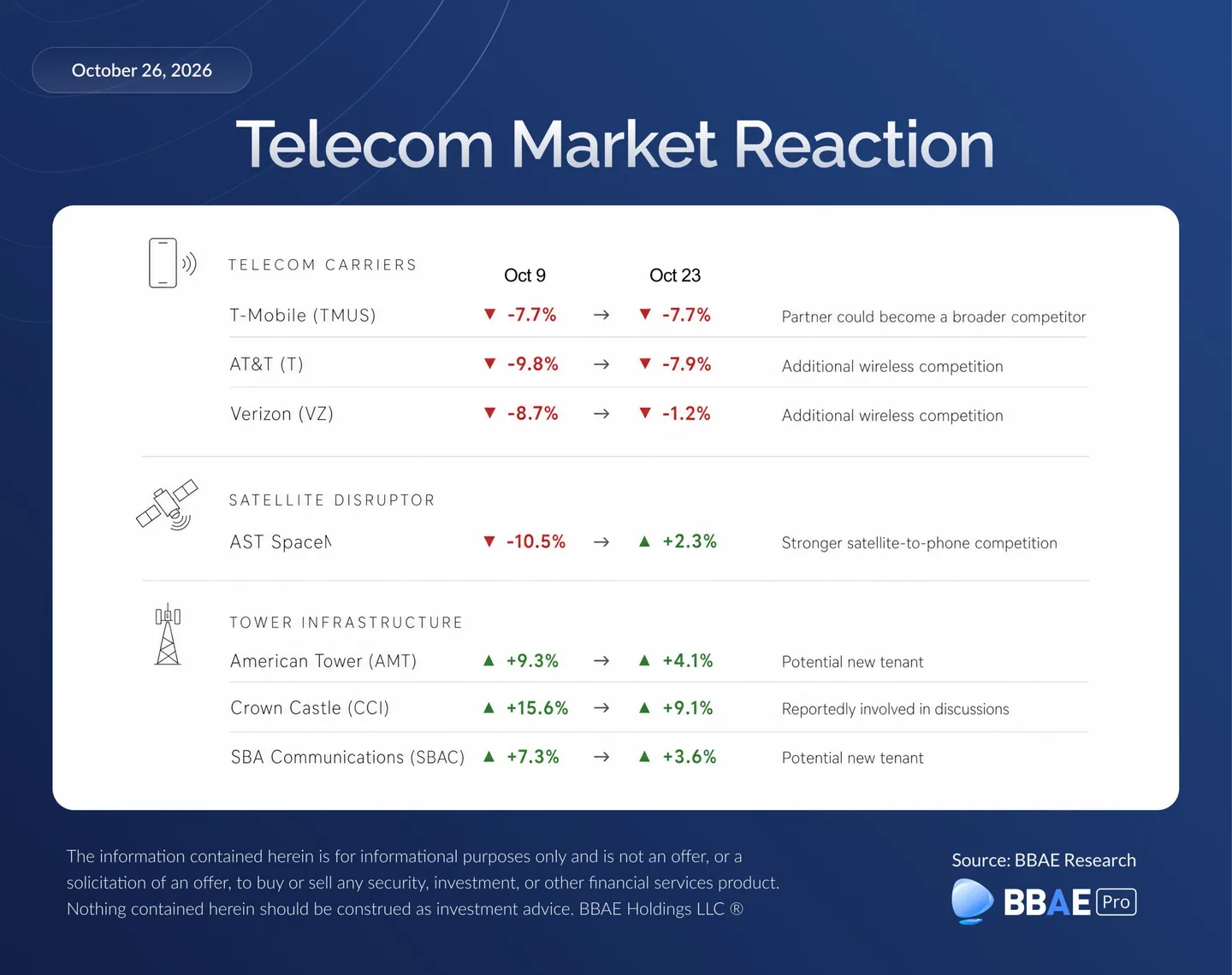
The initial market reaction reflects expectations about competition and potential new business. The long-term impact will depend on what SpaceX actually builds and how the industry responds.
A Different Wireless Industry Structure?
Satellite coverage could become another layer of conventional mobile networks: AT&T and Verizon supplemented by AST, and T-Mobile supported by its existing Starlink partnership.
SpaceX could potentially combine Starlink, its own spectrum and terrestrial infrastructure. Whether that becomes a direct consumer offering, wholesale service or another partnership structure remains unresolved.
What Comes Next?
The key questions are whether SpaceX will sell conventional mobile subscriptions, how that would affect T-Mobile, and whether site discussions produce signed contracts. Regulatory approvals and buildout costs also matter. For AST, satellite deployment and increasingly continuous coverage remain essential milestones.
The competitive question has expanded from filling cellular dead zones to whether a satellite company could become a broader wireless operator.
Carriers could face more competition, AST could face a stronger rival while remaining a useful partner, and tower companies could gain business. Actual leases, service announcements and deployment progress will show how much of that possibility becomes reality.
This article is for informational purposes only and is neither investment advice nor a solicitation to buy or sell securities. All investment involves inherent risks, including the total loss of principal, and past performance is not a guarantee of future results. Always conduct thorough research or consult with a financial expert before making any investment decisions. BBAE has no position in any investment mentioned.