Agility Robotics and $CCXI: Inside the $2.5 Billion SPAC Deal

Agility Robotics and $CCXI: Inside the $2.5 Billion SPAC Deal
Michael Klein’s Churchill Capital is preparing to bring another technology company to the public market. This time, the business is Agility Robotics, whose humanoid robots are already performing material-handling tasks in factories and warehouses.
Churchill Capital Corp XI ($CCXI) has scheduled a shareholder vote for November 2, 2026, on its proposed merger with Agility. The agreement assigns Agility an equity value of $2.5 billion, and the combined company plans to trade on Nasdaq under the symbol $AGLT following closing.
CCXI shares initially reacted strongly to the Agility Robotics merger announcement, climbing to around $19—roughly 90% above the SPAC’s original $10-per-share trust value. That substantial premium showed investors’ early enthusiasm for the humanoid robotics company ahead of the shareholder vote. Much of that enthusiasm has since faded from the share price, however. As the November 2 vote approaches, CCXI has moved back toward its cash redemption value, closing at $10.66 on Friday, October 16.
Readers may remember Klein from our earlier article, The Sam Altman SPAC: A Primer, which examined Oklo’s proposed combination with AltC Acquisition Corp. The connection is Michael Klein and the Churchill sponsorship network; CCXI is a separate vehicle, with Churchill Sponsor XI LLC as its sponsor.
Agility offers a different business to examine: robots that customers can put to work, a subscription model designed to generate recurring revenue, and a manufacturing facility built for much greater production. However, its financial statements show how early commercialization remains.
In this piece, I will review Agility’s business model, its proposed SPAC transaction, and the assumptions investors should understand before the vote.
What Is Agility Robotics?
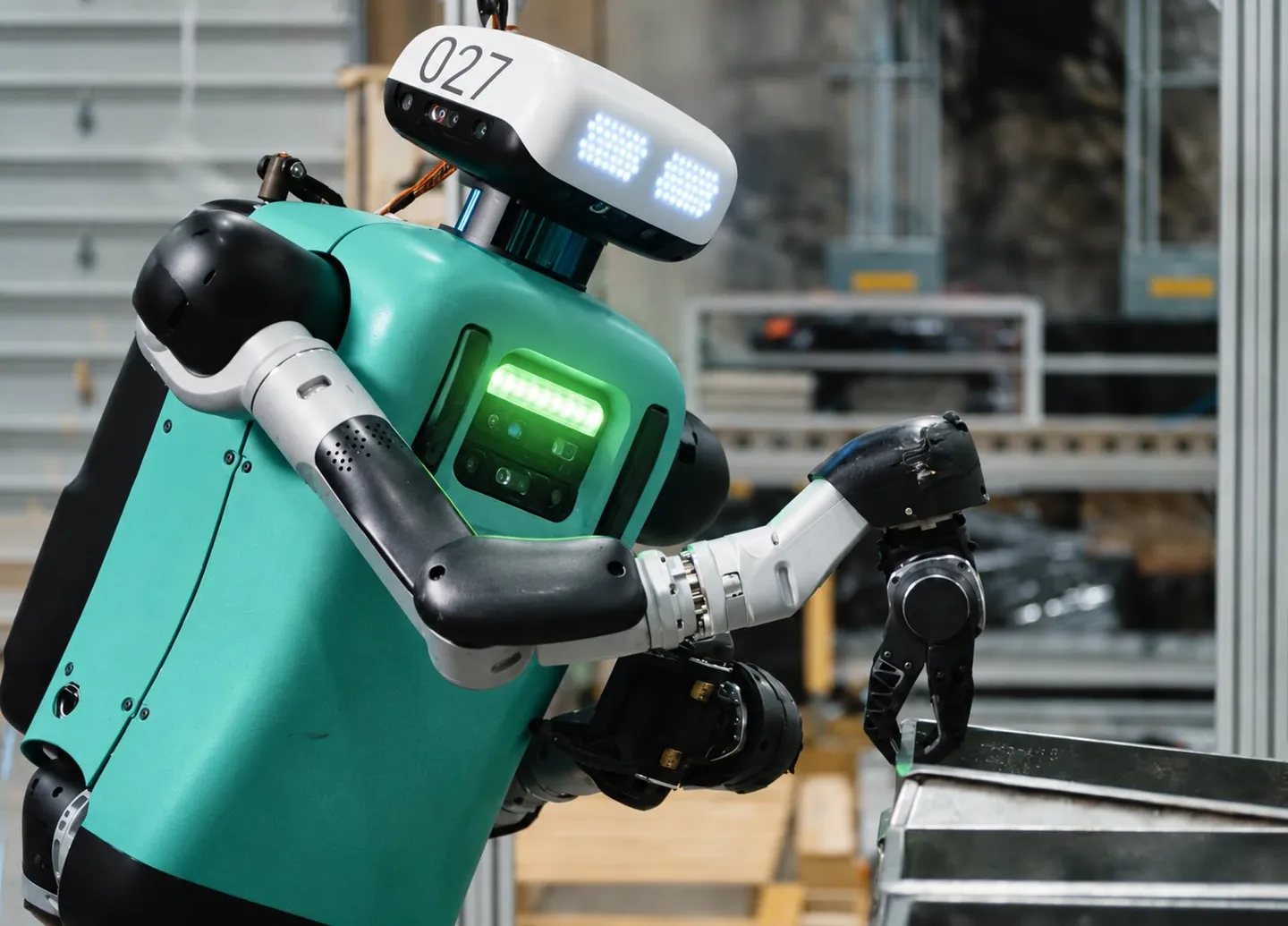
Founded in 2015, Agility develops humanoid robots designed to perform physical work in environments built for people. Its flagship product, Digit, combines walking, object handling, and software that allows it to carry out tasks in manufacturing, distribution, and logistics facilities.
The initial opportunity is relatively specific. Businesses need to move containers, replenish inventory, and perform repetitive material-handling work. Agility’s approach is to automate some of those tasks within existing facilities, rather than requiring customers to rebuild their operations around a fixed automation system.
The company is led by CEO Peggy Johnson, who joined in 2024 and previously held leadership roles at Qualcomm, Microsoft, and Magic Leap. Co-founder Jonathan Hurst brings a background in legged robotics and research at Oregon State University.
Agility also develops Agility Arc, its cloud platform for deploying robots, managing fleets, coordinating workflows, and distributing software updates. The commercial offering therefore combines hardware, software, and ongoing support.
How Much Work Are the Robots Already Doing?
According to the filing, Digit v4 had accumulated more than 65,000 hours of commercial operation across nine committed customer facility deployments as of May 2026. Customers named in the filing include Schaeffler, GXO, Toyota Motor Manufacturing Canada, and Mercado Libre.
At GXO, Digit reached a cumulative milestone of 100,000 totes handled in November 2025. The company reports approximately 98% operational accuracy while on-task at GXO. That measure describes task performance; it should not be interpreted as a disclosure of 98% uptime or continuous autonomous operation.
These deployments provide evidence that Digit can perform useful work in customer environments. They also generate operating data that Agility can use to improve its products. The next challenge is turning that experience into larger deployments with consistent revenue and acceptable costs.
The next-generation product is Digit 5, unveiled on September 15, 2026. Agility expects early access in the first half of 2027, with increasing availability over the following six to nine months. A central design objective is “cooperative safety,” meaning the ability to operate safely alongside people.
That capability matters commercially because physical barriers and restricted work areas can limit where robots operate. Investors should nevertheless distinguish the operating experience of Digit v4 from the planned capabilities and deployment schedule of Digit 5.
What Changes With Digit 5?
Capability | Digit v4 | Digit 5 management target |
Lifting capacity | Up to 35 pounds | Up to 50 pounds |
Vertical reach | Up to 5.5 feet | Up to 7.2 feet |
Maximum battery-supported operating hours per 24 hours | Approximately 16 hours | Approximately 22 hours |
End effectors, or handling attachments | Task-specific and fixed | Changeable |
Digit 5 figures are management expectations, rather than demonstrated performance across commercial deployments. Battery-supported hours do not establish productive uptime.
Greater reach and payload could expand the tasks a robot can perform. More operating time could also help spread the hardware investment across additional shifts. The commercial test will be whether those capabilities translate into dependable work at customer sites.
The June deck describes a planned 2026 release. The newer October prospectus reports the September unveiling and expects early customer access in the first half of 2027. Digit 5 has therefore been publicly unveiled, while early customer access and broader deployment remain ahead under the October timetable. This article uses that newer disclosure for availability.
Where Does NVIDIA Fit In?
The October prospectus describes Digit 5 as the inaugural humanoid launch partner for NVIDIA Halos for Robotics, combining NVIDIA IGX Thor and Halos Core infrastructure with Agility’s safety architecture.
The collaboration gives investors a specific connection to NVIDIA’s robotics technology. It does not establish customer demand, assure safety performance, or guarantee profitable production. Those outcomes still depend on Agility’s execution.
Business Model: Renting or Selling the Robot
Agility offers two main commercial models.
Under Robot-as-a-Service, or RaaS, Agility retains ownership of Digit and charges a recurring subscription that includes the robot, software, and maintenance. Customers can adopt automation with a smaller upfront investment, while Agility earns revenue over the deployment’s life.
The second model is a direct sale. The customer purchases Digit and continues paying for software and maintenance services.
The distinction affects Agility’s financing needs. Selling a robot brings in a larger payment near delivery. Keeping ownership under RaaS requires Agility to fund the hardware and recover that investment through subscription payments over time. A growing subscription business could therefore require substantial cash before it produces attractive returns.
Agility has also established a Customer Acceleration Program, which takes prospective customers through technical evaluation, an on-site proof of concept, and a commercial RaaS deployment. Participation carries a program fee of approximately $500,000. As of May 2026, four new customers had signed up.
Paying to evaluate the technology demonstrates interest, but participation does not guarantee a scaled commercial deployment.
Digit 5’s Illustrative Unit Economics
Agility’s prospective unit economics help explain the intended business model. These are unaudited management assumptions, rather than demonstrated financial results.
Assumption | Robot-as-a-Service | Direct ownership |
Assumed robot useful life | 5 years | 5 years |
Upfront robot purchase price | Included in subscription | Approximately $200,000 |
Initial customer deployment fee | Approximately $25,000 | Approximately $20,000 |
Recurring customer payments | $8,500 per month | Approximately $36,000 annually for software and maintenance |
Robot bill of materials at commercial launch | Approximately $150,000 | Approximately $150,000 |
Agility’s annual software and maintenance delivery cost | Approximately $15,000 | Approximately $15,000 |
The most important manufacturing assumption is a substantial reduction in the bill of materials—the components used to build each robot. Agility targets approximately $75,000 per robot at annual production of 1,000 units and approximately $30,000 at 10,000 units.
Those reductions would materially change the economics of a subscription priced at $8,500 per month. They depend on reaching production volumes and achieving manufacturing and supply-chain improvements that have yet to be demonstrated at that scale.
The bill of materials also does not represent the full cost of running the company. Research and development, corporate expenses, and other spending still have to be funded. Favorable economics for an individual robot would not by themselves establish company-wide profitability.
The $300 Million Order Commitment
Agility reports approximately $300 million of committed multiyear Digit 5 orders as of May 2026. The filing’s unit-economics footnote ties these orders to 1,000 robots under a three-year RaaS contract.
There are several qualifications. The commitment comes from one customer and depends on contractual milestones, product features, and specifications. The arrangement also includes warrants issued to the purchaser that vest proportionately as robots are deployed.
This is potential revenue over several years, subject to execution. It is not cash already received or revenue already recognized.
The commitment gives Agility a meaningful commercial target. It also creates concentration risk: a delay in meeting that customer’s requirements could have a substantial effect on the deployment schedule and revenue outlook.
SPAC Transaction Structure
The merger agreement assigns $2.5 billion of equity value to Agility’s existing stockholders, option holders, and convertible-security holders. The consideration will be paid in shares. This figure should not be confused with the cash Agility will receive or a guaranteed post-merger market capitalization.
The principal funding components are:
- Approximately $420.9 million held in CCXI’s trust account at June 30, 2026, before shareholder redemptions.
- A committed $201.025 million private investment in public equity, or PIPE, priced at $10 per share and subject to closing conditions.
- A minimum closing cash condition of $200 million, as defined in the merger agreement.
The filing illustrates approximately $621.9 million of gross trust and PIPE proceeds with no redemptions, falling to approximately $201 million if all public shares are redeemed. After approximately $46.1 million of estimated transaction expenses, the corresponding net proceeds are approximately $575.8 million and $154.9 million.
These figures exclude the separate $100 million SAFE financing. The minimum cash condition uses the agreement’s defined cash measure; it should not be read as a promise of $200 million remaining after every transaction expense.
The filing’s illustrative ownership table shows the following:
Shareholder group | No redemptions | Maximum redemptions |
Existing Agility stockholders | 71.8% | 84.9% |
Sponsor | 5.3% | 6.3% |
CCXI public shareholders | 15.4% | 0.0% |
PIPE investors | 7.5% | 8.8% |
These are scenario illustrations, rather than a final fully diluted capitalization table. They use the filing’s stated assumptions and exclude specified potential issuances, including shares underlying outstanding Agility options and future equity-plan awards.
Manufacturing and Competition
Agility’s RoboFab facility in Salem, Oregon, is operating and producing robots. Its designed capacity is up to 10,000 robots annually, but that figure describes the facility’s intended capacity rather than current annual output.
The distinction matters because Agility’s cost targets depend on volume. The company needs customer demand, reliable manufacturing, and sufficient financing to move toward the production levels underlying its illustrative economics.
The filing identifies competitors including Boston Dynamics, Tesla, Figure AI, Apptronik, and other humanoid developers. Agility also competes against conventional automation, including fixed robots and autonomous mobile robots.
Customers will assess whether a humanoid offers a better return for a particular task than those alternatives. Flexibility is valuable only if reliability, deployment costs, and productivity support the investment.
What Should Shareholders Watch Before the Vote?
The shareholder meeting is scheduled for November 2, 2026, at 9:00 a.m. Eastern Time. The filing gives a redemption deadline of October 29, 2026, at 5:00 p.m. Eastern Time, subject to the procedures and qualifications described in the prospectus. Investors holding through a broker should check its processing deadline.
Voting and redemption are separate decisions. Public shareholders may exercise redemption rights whether they vote for or against the transaction, provided they satisfy the requirements. The filing gives an illustrative redemption value of $10.24 per share based on the September 14 record-date trust balance; the final amount is determined under the applicable formula.
Beyond the vote, the most useful milestones will be Digit 5’s early-access launch, conversion of conditional orders into deployments and recognized revenue, actual manufacturing costs, and cash remaining after closing.
Conclusion
Agility brings real deployment experience to an emerging robotics market. Its subscription model offers a potential source of recurring revenue, and its customer relationships provide a foundation for expansion.
However, investors are being asked to assess a $2.5 billion equity valuation while current revenue remains very small. The commercial case depends heavily on a new product, substantial manufacturing cost reductions, and a concentrated order commitment with conditions attached.
As with the Klein-backed transaction discussed in our earlier Oklo article, the sponsor’s experience is one part of the story. For Agility, the more consequential question is whether operating experience can translate into a scalable business before further financing becomes necessary.
This article is for informational purposes only and is neither investment advice nor a solicitation to buy or sell securities. All investments involve inherent risks, including the total loss of principal, and past performance is not a guarantee of future results. Investing in initial public offerings (IPOs) carries additional risks, such as volatility, limited operating history, lack of liquidity, and potential overvaluation. IPO stocks may experience significant price fluctuations and may not perform as expected. Always conduct thorough research or consult with a financial expert before making any investment decisions. BBAE has no position in any investment mentioned.