Anthropic ($ANT) IPO: An Investor’s Guide to the AI Lab

Anthropic ($ANT), the AI company behind the Claude family of models, filed Amendment No. 2 to its S-1 with the SEC on November 10, 2026, ahead of a planned Nasdaq Global Select Market listing under the ticker symbol $ANT. The company is expected to begin trading this week. Unlike most filings we cover, this one includes an indicated price range of $70 to $78 per share on a base offering of 825 million Class A shares, though the final price and the total amount raised will not be set until pricing, immediately before trading begins. In this article, we will review the company’s business model, its financial performance, the compute commitments at the center of the story, and the terms of the offering.
Business Model
Anthropic sells access to Claude, its family of frontier AI models, in four classes positioned at different points on the capability, cost, and speed spectrum: Mythos, which includes Fable, along with Opus, Sonnet, and Haiku. Customers reach Claude through Anthropic’s own applications and APIs, or through cloud marketplaces including AWS, Google Cloud, and Microsoft Azure, where Anthropic generally keeps the direct customer relationship and pays the provider a fee.
The dominant model is what Anthropic calls pay-for-intelligence: customers are charged by how many tokens they consume and which model they choose, with larger customers increasingly signing multi-year contracts carrying minimum spending commitments. The company also sells subscriptions, including Claude Pro, Max, and Ultra.
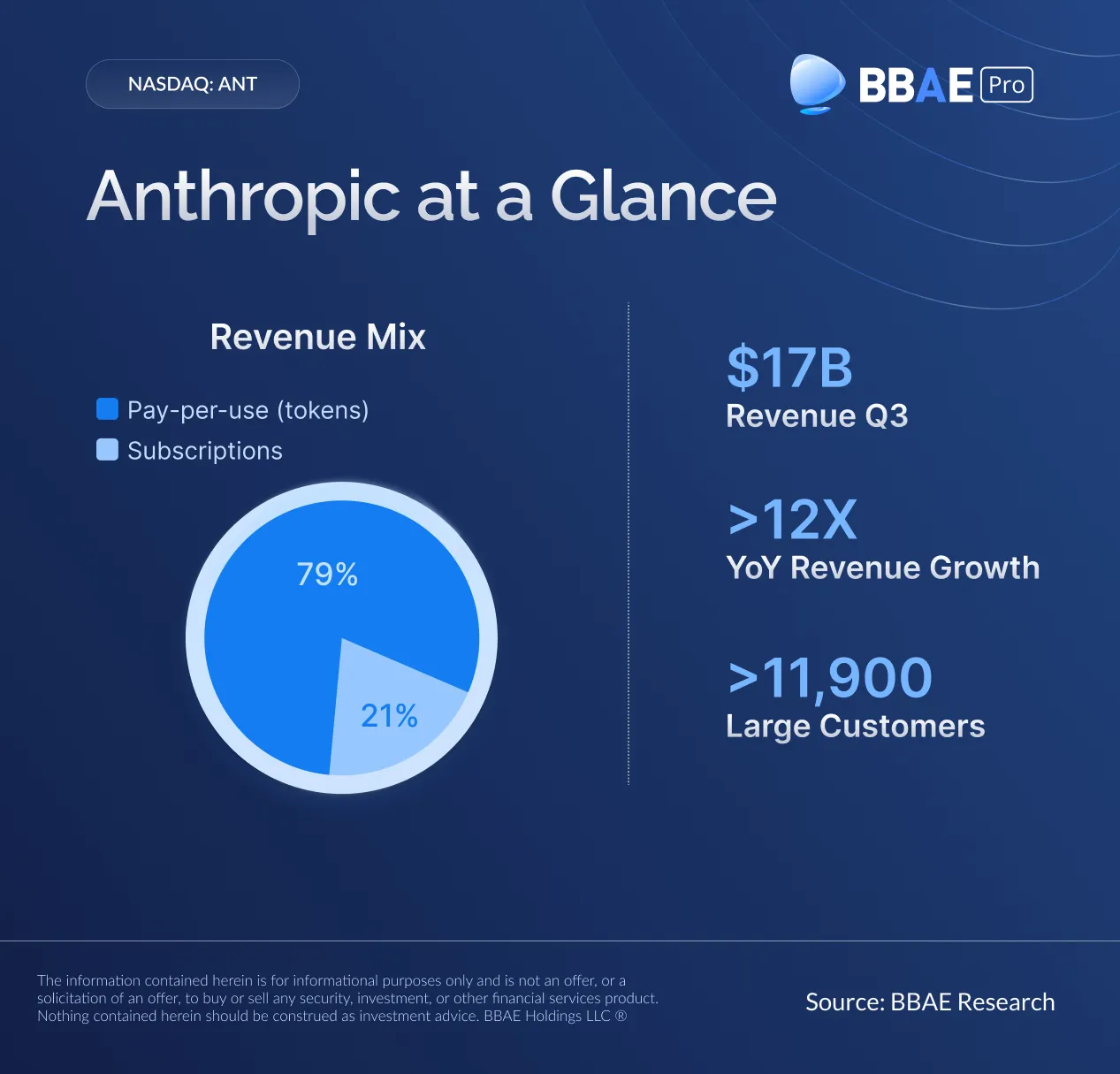
The split tells you what kind of company this is. In the first nine months of 2026, consumption revenue was $26.3 billion, or 79% of the total, against $6.9 billion from subscriptions, and Anthropic expects that mix to hold. This is a usage-based business rather than conventional subscription software, so revenue can move quickly with customer workloads, pricing, and model preference. The filing warns that customers may shift work to cheaper models or cut usage.
Financial Numbers and Key Metrics
At a glance:
- Nine-month 2026 revenue: $33.2 billion, up 1,206% from $2.5 billion a year earlier
- Full-year 2025 revenue: $4.6 billion, up 1,088% from $386 million in 2024
- Nine-month operating loss: $1.3 billion, a negative 4% margin, versus negative 205% a year earlier
- Nine-month adjusted operating income: $4.1 billion, a positive 12% margin
- Nine-month operating cash flow: positive $6.6 billion, versus a $2.0 billion outflow a year earlier
- Liquidity at September 30: $95.6 billion cash, $36.3 billion short-term investments, $14.8 billion undrawn credit
Revenue went from $41 million in 2023 to $386 million in 2024, then $4.6 billion in 2025, and $33.2 billion in the first nine months of 2026 alone. The unit economics improved along the way: compute and infrastructure expense rose 329% in the nine-month period while revenue rose more than twelvefold, pushing compute from 172% of revenue down to 57%.
Two numbers need careful handling. The headline net loss was $104.0 billion, but that is not a measure of operating performance. Roughly $94.3 billion came from fair-value changes in convertible notes and related instruments, largely because a rising valuation increased the carrying value of those liabilities. Adjusted net income, which strips those out, was $5.6 billion.
The second is gross margin. Anthropic stopped presenting gross profit on the income statement in 2025, but the notes still disclose a functional cost of revenue, producing a calculated gross margin near 85.5% for the period, up from 29.4%. That flatters the business, because only customer-serving compute sits in cost of revenue while the far larger amounts consumed by research and model development sit in R&D.
Cash generation has inflected too. That does not mean Anthropic funds its own expansion: financing activities supplied another $110.7 billion over the same period, mostly from preferred-equity issuance.
Customers and Retention
Customers generating at least $100,000 of trailing-twelve-month revenue grew from roughly 20 at the end of 2023 to more than 11,900 by September 30, 2026, producing about $24.5 billion, or 74% of revenue, in the first nine months. More than 1,900 generate at least $1 million, and more than half the Fortune 500 clears the $100,000 threshold.
The most striking metric is net revenue retention of approximately 900%, which compares what existing customers spend now against what the same group spent a year earlier. Anthropic notes that its operating metrics come from internal systems and judgments, have not been independently verified, and that it expects growth rates to decline materially as the revenue base grows.
Concentration has improved sharply. One customer was 43% of revenue in 2023; by the first nine months of 2026, none accounted for 10% or more. Some remains downstream: receivables through cloud marketplaces were 52% of the total, which matters because Amazon, Google, and Microsoft are simultaneously suppliers, distributors, investors, customers, and competitors.
The Compute Commitments
This is the central financial disclosure in the filing. Anthropic reports approximately $900.9 billion of purchase commitments and lease agreements, substantially all tied to compute and infrastructure. Roughly $451.6 billion is expected before the end of 2030, and about $70.7 billion falls due in the twelve months after September 30. About $186.2 billion is subject to termination rights or conditions such as financing or regulatory approval.
Set against that, disclosed liquidity before the IPO was $146.6 billion, and the offering plus private placement would add roughly $84.6 billion at the midpoint. The commitments are many times larger, spread over nearly two decades, so future cash generation and continued access to capital are structural requirements rather than optional extras.
The bull case is that Anthropic keeps converting each dollar of compute into more revenue: in the September quarter, revenue grew 1,127% year over year while compute expense rose 382%. The bear case is that commoditization, pricing pressure, or a demand slowdown leaves the company paying for capacity committed years in advance. The filing warns that many of these commitments must be honored regardless of actual usage.
IPO Structure and Governance
The base offering is 825 million Class A shares, with Anthropic selling 801.35 million and existing holders the rest, plus an underwriters’ option on 123.75 million more. Alongside it, Google, NVIDIA, AMD, Broadcom, Micron, Microsoft, and TSMC have agreed to buy $26 billion of non-voting Class N shares at the IPO price, turning several of Anthropic’s largest suppliers into shareholders. Net proceeds are estimated at $84.6 billion including that placement, headed for working capital, compute and infrastructure, hiring, and possible acquisitions. At the $74 midpoint, the roughly 13.1 billion participating shares outstanding afterward imply a post-offering equity value near $968 billion.
Governance departs sharply from a typical listing. Class A buyers get one vote per share but will not control the company: a founder-controlled LLC holds a single Class F share carrying 50.1% of voting power, fixed even as more shares are issued, and the Long-Term Benefit Trust can elect a majority of the board through its Class T share. Nasdaq treats Anthropic as a controlled company. This is deliberate, since Anthropic is a Delaware public benefit corporation whose charter requires weighing its stated public benefit alongside shareholder economics.
Buyers also face substantial accounting dilution: at $74, pro forma adjusted net tangible book value is $8.21 per share, implying about 89% immediate book-value dilution. Other disclosed risks include competition from Google and OpenAI, short model cycles, with models released in the six months to September 30 generating more than 80% of third-quarter revenue, plus copyright litigation and dependence on scarce electricity, chips, and data-center capacity.
Conclusion
Anthropic arrives with a growth record few companies have matched, from $41 million of revenue in 2023 to $33.2 billion in the first nine months of 2026, with operating margin improving to roughly negative 4% and operating cash flow swinging to a $6.6 billion inflow.
The counterweights are just as large. Roughly $900.9 billion of compute commitments dwarf both current liquidity and IPO proceeds, and many stand regardless of usage. The calculated gross margin overstates the economics, the headline net loss is dominated by non-cash charges, and public shareholders will hold economic rights without meaningful control.
With shares expected to begin trading this week, the open questions are the final price and the eventual size of the raise. Beyond that, the metrics worth tracking are consumption growth, retention as the base scales, compute expense as a share of revenue, and whether new infrastructure commitments keep pace with the revenue they are meant to produce.
This article is for informational purposes only and is neither investment advice nor a solicitation to buy or sell securities. All investments involve inherent risks, including the total loss of principal, and past performance is not a guarantee of future results. Investing in initial public offerings (IPOs) carries additional risks, such as volatility, limited operating history, lack of liquidity, and potential overvaluation. IPO stocks may experience significant price fluctuations and may not perform as expected. Always conduct thorough research or consult with a financial expert before making any investment decisions. BBAE has no position in any investment mentioned.