


Software Stocks Tumble Amid Generative AI Fears
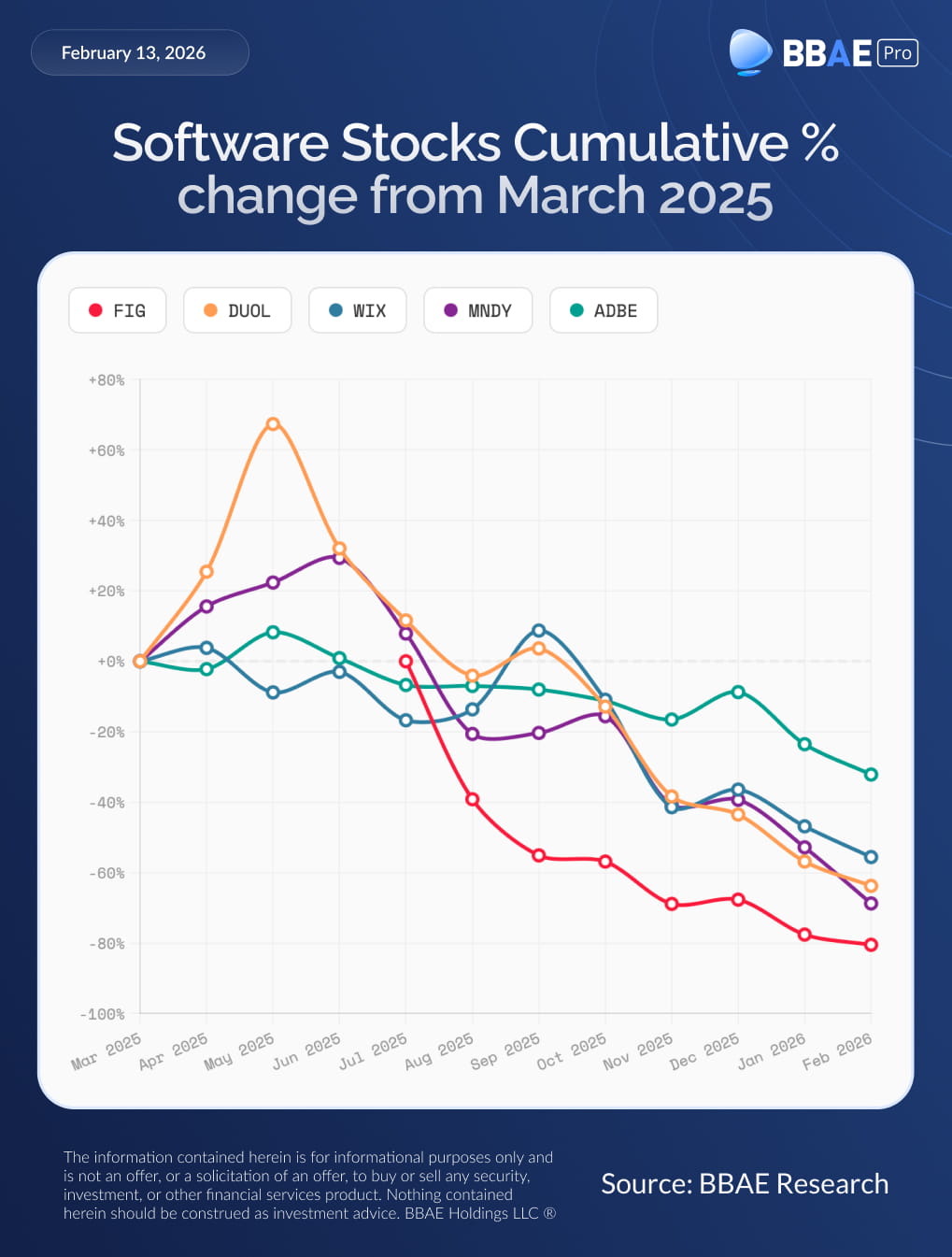
Over the last 12 months, a broad sell-off has swept through software stocks as investors worry that generative AI will upend traditional software business models. The sell-off has especially accelerated in recent months as increasingly capable AI models and tools have come to market, with the downturn intensifying sharply at the beginning of 2026. Companies across SaaS, design, education, and productivity software have seen their valuations plunge, in most cases despite little fundamental deterioration, though some have already seen real business impact from AI competition.
As AI tools emerged to automate legal and knowledge work, fears that “no software niche is safe” prompted broad institutional selling. Even large incumbents like Salesforce and ServiceNow suffered steep declines as the market questioned whether their AI initiatives would translate into revenue fast enough. Meanwhile, AI infrastructure plays like chipmakers soared, reinforcing the narrative that infrastructure might capture more value than application-layer software.
Some companies have taken a particularly hard hit, with their stocks crashing well beyond the broader sector decline. In this article, we review the stocks most impacted by AI fears and examine why each has been singled out by the market.
Duolingo ($DUOL)
Duolingo’s share price collapsed over 45% in 2025, despite the company’s financial metrics looking healthy; revenue jumped 41% year-over-year in Q3 2025, monthly active users reached 135 million, and paid subscribers hit 11.5 million. The company achieved a 13% operating margin and generated positive free cash flow.
The fear is that free AI chatbots like ChatGPT could render a structured learning app obsolete. CEO Luis von Ahn acknowledged that AI is rapidly improving at educational tasks. When management announced a strategic shift prioritizing user growth over short-term monetization, the stock dropped 25% in a day as investors interpreted it as a sign of competitive pressure.
Duolingo was actually an early adopter of GPT-4, launching “Duolingo Max” in 2023 with AI-powered conversational practice. The company is also using AI internally to reduce content creation costs. Management argues that pure AI chatbots lack the gamification, structure, and motivation that drive Duolingo’s engagement, noting that millions treat the app like an addictive daily habit that a blank chat interface cannot replicate.
Figma ($FIG)
Figma, the leading collaborative interface design platform used by millions of designers worldwide, saw its stock soar from a $33 IPO price to a $142.92 peak by August 2025, then plunge to around $26.79 by January 2026 and briefly hit under $20 in February, erasing its post-IPO gains and reaching half the market cap that Adobe was willing to pay in 2022. Despite this, the business has been booming: revenue grew 38% year-over-year in Q3 2025, reaching $274 million. Figma remains the de facto industry standard for collaborative interface design.
The core fear is that generative AI could automate UI design itself. Figma candidly acknowledged in its IPO filings that AI could potentially “destroy its entire business model.” Investors worry that if AI can generate high-quality designs from a prompt, demand for collaborative design tools could wane.
Figma has responded aggressively, acquiring AI design startup Weavy and launching “Figma Make,” an AI-powered tool now used weekly by roughly 30% of customers. The strategy is to use AI as a creative collaborator rather than fight it as a competitor.
Monday.com ($MNDY)
Monday.com, a widely used work management platform that helps teams plan, track, and collaborate on projects, saw its shares fall roughly 37% in 2025, declining from around $340 to about $150, followed by another 50% plunge in early 2026 to $73. For the full year 2025, revenue reached $1.232 billion, up 27% year-over-year.
Investors worry that AI could automate project tasks, reducing the need for dedicated work management platforms. Monday.com’s general-purpose nature makes it theoretically more vulnerable to AI disruption than specialized tools.
The company launched AI enhancements including “monday Vibe,” which surpassed $1 million in ARR within 2.5 months of launch. monday.com is also pushing aggressively into enterprise customers, which tend to adopt changes more slowly and require compliance and integration features that startups cannot easily provide.
Wix ($WIX)
Wix, a platform that enables anyone to create and host professional websites without coding, saw its stock plunge 51.6% in 2025, and by January 2026 shares were down nearly 80% from their 2021 highs. Despite this, revenue grew 14% year-over-year in Q3 2025, the company was nearing $2 billion in annual revenue, and generated over $500 million in free cash flow.
The threat is direct: AI systems can now build entire websites automatically from a short business description. This potentially lowers switching costs that historically kept Wix customers locked in and commoditizes basic web design. AI startup Base44, which enables website creation through natural language.
Wix responded by acquiring Base44 itself, integrating the technology into its platform. The company also launched an “AI Site Generator” and “Project Harmony” initiative focused on AI-powered website building and next-generation design tools. Despite these moves, the market remains fearful as competition comes from all sides, including AI agents like Manus and Claude Code that can generate full websites and web applications from simple prompts.
Adobe ($ADBE)
Adobe, the dominant force in creative and document software with products like Photoshop, Illustrator, and Acrobat, saw its stock fall roughly 21% in 2025 and another 25% in 2026 despite being one of the earliest and most aggressive adopters of generative AI. Revenue grew 11% to a record $23.8 billion in FY2025, and users generated over 24 billion AI images through Adobe’s Firefly generative engine. AI-influenced ARR now accounts for a third of the company’s business.
The fear is that AI will commoditize creative tools. As AI text-to-image and text-to-design tools become increasingly capable, casual users and even professionals might bypass expensive software like Photoshop for free or low-cost AI alternatives that can produce quality results from a simple prompt. The market essentially told Adobe: strong AI execution today does not guarantee protection from cheaper AI-powered alternatives tomorrow.
Chegg ($CHGG)
Chegg, an online education and tutoring platform used by millions of students for homework help and study resources, became the earliest and most dramatic cautionary tale of AI disruption. In May 2023, Chegg’s CEO admitted that ChatGPT was directly hurting new subscriber growth, and the stock promptly lost nearly 50% in a single day. That was just the beginning: as students increasingly turned to free AI tools for homework assistance, Chegg’s stock kept falling, ending down around 99% from its 2021 highs by early 2026.
Unlike many companies on this list, Chegg’s business fundamentals actually did deteriorate. Subscriber growth stalled and then reversed as the core value proposition of on-demand homework answers was effectively replicated for free by AI chatbots. Chegg attempted to launch its own AI study helper, but the market remains deeply skeptical about whether a paid service can compete when the free alternative is increasingly capable.
The “Chegg incident” arguably primed the entire investor community to look for similar AI risks across software sectors. It demonstrated that AI disruption was not theoretical; it could materially impact a company’s revenue and user base in a matter of quarters, not years.
Other Notable Declines
Several other major software companies were caught in the same crossfire. Salesforce declined in 2025 despite launching its “Agentforce” AI platform with $500M+ in ARR growing 330% year-over-year; CEO Marc Benioff himself warned that AI agents could reduce the need for human seats, undermining Salesforce’s own licensing model. ServiceNow slid despite solid results, as the market did not discriminate in punishing software names. Bill.com fell on fears that AI could automate the accounts payable and receivable tasks its software handles. Atlassian declined despite revenue growing 23% year-over-year and deeply embedded enterprise workflows that create significant switching costs. Asana continued its multi-year slide, with its stock now down about 90% from 2021 highs, though the company reached non-GAAP profitability and is repositioning around AI-powered workflow orchestration.
A notable bifurcation emerged between perceived “AI winners” and “AI losers.” Companies seen as AI-native or indispensable, like Palantir and cybersecurity firms, performed well. Horizontal, SMB-focused SaaS names were hit hardest. The market drew a clear line: if a business delivered something AI cannot easily replicate, it fared better. If it was broad-purpose or reliant on lots of human users, it was treated with suspicion.
This article is for informational purposes only and is not investment advice or a solicitation to buy or sell securities. The content is based on publicly available information and reflects the author’s opinions as of the publication date, which may change without notice. All investments carry inherent risks, including the potential loss of principal, and past performance is not indicative of future results. Readers should conduct their own research or consult a financial advisor before making investment decisions. BBAE holds no position in the securities mentioned, nor are they compensated by the companies mentioned.