

2025 IPO Market Review and 2026 Expectations
After the historic IPO boom of 2021, the market saw a steep decline in deal activity in 2022. Since then, the IPO market has been slowly recovering from that downturn. In 2025, activity reached its strongest level since the decline, with several exciting companies going public. The SPAC market also showed signs of recovery. While volumes remain well below 2021 peaks, 2025 represented a meaningful improvement compared to the previous years. In this article, I review the 2025 IPO market and outline expectations for the year ahead.
2025: A Year of Recovery
In 2025, the U.S. IPO market saw approximately 340 offerings, up from around 240 the year before. A significant portion of the recovery came from the SPAC market: roughly 140 of this year’s IPOs were SPAC listings, compared with just 57 SPAC IPOs last year—nearly a threefold increase. While activity remains well below the 2021 peak, when more than 1,000 companies went public, 2025 still marked a meaningful improvement over the past several years.
The IPO revival in 2025 was led by the technology sector, particularly companies tied to artificial intelligence. On the SPAC side, crypto-treasury company mergers emerged as a key trend. The year saw several blockbuster tech debuts that captured investor attention. One of the most prominent was CoreWeave ($CRWV), an AI-focused cloud infrastructure provider. A former crypto mining firm that pivoted into AI cloud services for customers such as Microsoft, CoreWeave went public in April 2025 and saw its shares surge. The stock has climbed roughly 185% from its $40 IPO price, giving the company a market capitalization of more than $50 billion. This strong post-IPO performance highlights how aggressively investors rewarded companies tied to the AI boom, as demand for AI computing power accelerated in 2025 despite intense competition. CoreWeave’s debut, amid a broader wave of AI investment, showed that public markets were willing to pay a premium for infrastructure businesses enabling the AI build-out.
Another major IPO was Figma ($FIG). The design software company raised more than $1.2 billion in its August 2025 IPO. Investor demand was exceptionally strong, with the offering heavily oversubscribed. Figma’s shares more than tripled from their $33 IPO price in the days following the debut, before pulling back several months later.
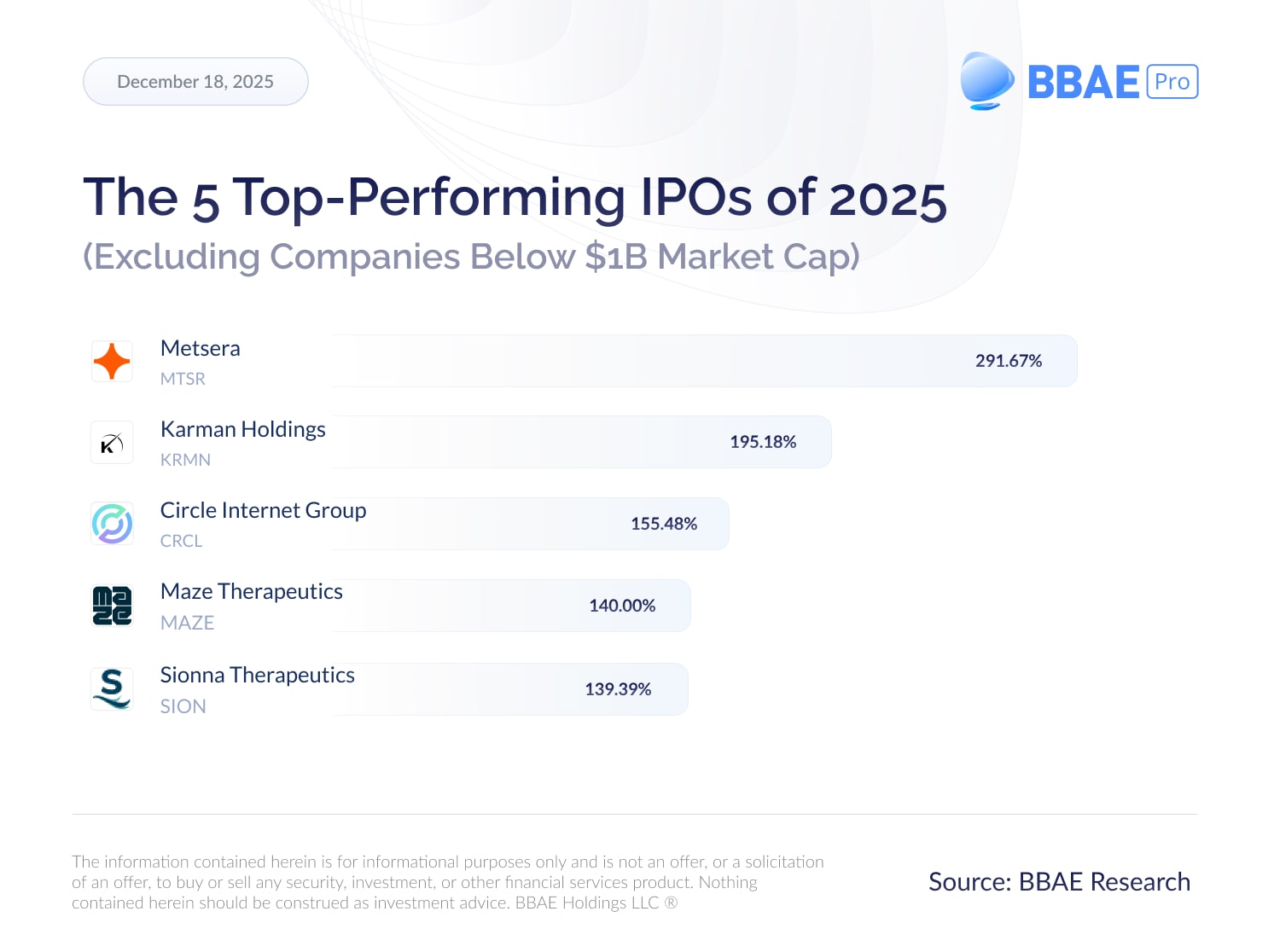
Another big winner was Circle Internet Group ($CRCL). The issuer of the USDC stablecoin chose a traditional IPO in June 2025 and delivered a standout debut. Circle’s shares closed up 168% on their first trading day and later reached highs near $299 per share, almost 10× its IPO price. Investor demand was driven by interest in Circle’s crypto payments business, with the listing coinciding with a broader crypto rally as Bitcoin approached all-time highs at the time. The strong reception created a halo effect across the sector, encouraging other crypto-focused companies such as BitGo and Gemini to pursue public listings as confidence returned to digital asset IPOs.
The largest IPO of the year priced this week, and it came from outside the tech sector. Medical supply company Medline ($MDNL) priced its offering at $29 per share on Tuesday, raising $6.26 billion in an upsized deal. The stock closed its first trading day at $41, representing a gain of about 40% from the IPO price. Medline’s strong debut capped off a solid year for new listings and helped reinforce optimism for the IPO market heading into 2026.
On the SPAC side, 2025 marked a shift away from the post-2021 stagnation toward a new, more concentrated trend. After years of regulatory pressure that kept most SPACs trading near their $10 net asset value, investor attention returned to a small number of deals built around strong narrative-driven themes. Activity was defined by selective enthusiasm for SPACs tied to areas such as crypto treasury strategies, AI infrastructure, and automation. Several transactions began trading meaningfully above trust value, signaling renewed speculative interest and a willingness among investors to re-engage with the SPAC structure when the story resonated. While overall volumes remained well below the 2021 boom, 2025 showed that SPACs could still capture market momentum under the right thematic conditions.
List of the 5 Largest IPOs of 2025
| Ticker | Name | IPO Price | Current Price | Return | IPO Size |
| MDLN | Medline Inc. | $29.00 | $29.00 | 41.38% | $6.26B |
| VG | Venture Global, Inc. | $25.00 | $25.00 | -76.24% | $1.75B |
| CRWV | CoreWeave, Inc. | $40.00 | $40.00 | 61.38% | $1.50B |
| SAIL | SailPoint, Inc. | $23.00 | $23.00 | -11.39% | $1.38B |
| KLAR | Klarna Group plc | $40.00 | $29.00 | -26.38% | $1.37B |
The 5 Top-Performing IPOs of 2025 (Excluding Companies Below $1B Market Cap)
2026 Outlook: Anticipation of a Robust Market
Market conditions in 2025 were far more supportive than in the prior two years. Easing inflation and the prospect of lower interest rates helped improve investor sentiment, while the resilience of the broader equity market allowed IPOs to price more ambitiously and still trade higher after listing. Investor appetite returned, particularly for growth-oriented offerings in sectors with long-term tailwinds, and first-day performance improved meaningfully compared with the disappointing outcomes of 2022 and 2023. By year-end, U.S. IPO activity was running well ahead of 2024’s pace, pointing to a sustained recovery rather than a short-lived rebound.
Looking ahead, the pipeline of potential issuers remains large. Many late-stage private companies and long-standing unicorns that stayed private during the downturn are now considering listings in 2026, encouraged by the success of recent IPOs. Speculation has also increased around a possible SpaceX IPO next year, which, if it happens, would rank among the most closely watched public offerings in years. While a return to the speculative excesses of 2021 appears unlikely, the experience of 2025 suggests the market has reached a healthier balance. Investors are once again willing to back growth IPOs, but with greater selectivity, giving retail investors more opportunities to access innovative companies while still requiring careful attention to valuation and fundamentals.
This article is provided for informational and educational purposes only and does not constitute investment advice, an offer, or a solicitation to buy or sell any security, including any initial public offering (“IPO”). The content reflects general market observations regarding IPO activity in 2025 and potential considerations for 2026 and is not intended to predict future market performance or outcomes.
Investing in IPOs involves heightened risks, including but not limited to limited operating history, increased price volatility, reduced liquidity, lock-up expirations, and the potential for a complete loss of invested capital. Past performance of IPOs or broader market trends is not indicative of future results.
Any forward-looking statements or expectations discussed are subject to change and are based on current market conditions, which may differ materially in the future. Readers should not rely on this information as a substitute for personalized investment advice.
Investors are encouraged to conduct their own independent research, review applicable offering documents (including prospectuses), and consult with a qualified financial, legal, or tax professional before making any investment decision.
BBAE does not hold positions in, and does not receive compensation related to, any specific IPO or security referenced in this article.